Ever found yourself rewatching footage, only to be distracted by a jarring, shaky camera? It’s a common frustration for anyone trying to capture professional-looking videos. Fortunately, gimbals have revolutionized video stabilization, transforming wobbly shots into effortlessly smooth, cinematic sequences. But as you delve into the world of camera stabilizers, you’ll quickly encounter a key distinction: 2-axis versus 3-axis gimbals. Understanding this fundamental difference is crucial for selecting the right tool to elevate your creative vision. This guide will unpack the mechanics, advantages, and ideal applications of both types, helping you make an informed decision for your next project.
Understanding Gimbal Fundamentals
At its heart, a gimbal is a pivoted support that uses motors and sensors to keep a camera or other device stable, counteracting unwanted movements in real-time. Imagine trying to hold a camera perfectly steady while walking, running, or even just turning. Gimbals do this work for you, allowing the camera to float smoothly regardless of external motion.
The stabilization capabilities of a gimbal are defined by the number of axes it controls. In three-dimensional space, there are three primary axes of rotation:
- Pitch (Tilt): This is the up-and-down movement, like nodding your head or tilting a camera to look upwards or downwards.
- Roll: This refers to the side-to-side rotation, similar to tilting your head towards your shoulder or a boat rocking on waves.
- Yaw (Pan): This is the left-to-right horizontal rotation, akin to shaking your head “no” or panning a camera across a landscape.
Each axis represents a direction in which the gimbal can actively compensate for movement, ensuring your footage remains steady and level.
Exploring 2-Axis Gimbals: The Essential Stabilizers
A 2-axis gimbal provides stabilization along two of these three crucial axes: pitch and roll. This means it can effectively correct for vertical tilting (up and down) and horizontal tilting (side to side), significantly reducing the most common jitters and shakes that plague handheld footage.
These gimbals operate using brushless motors and gyroscopic sensors. When the sensors detect an unwanted movement in either the pitch or roll direction, the motors instantaneously apply counter-movements to keep the camera level. Think of it as having an incredibly steady hand that can absorb sudden dips and leans.
Key Advantages of 2-Axis Gimbals
For many users, 2-axis gimbals offer a compelling set of benefits:
- Lightweight and Portable: With fewer motors and components, 2-axis gimbals are generally lighter and more compact. This makes them ideal for travel, backpacking, or situations where minimizing gear weight is a priority.
- More Affordable: Typically, 2-axis models come at a lower price point than their 3-axis counterparts, making them an accessible entry point into stabilized videography.
- Longer Battery Life: Fewer motors mean less power consumption, often resulting in extended battery life—a significant advantage during long shoots or when power sources are limited.
- Simplicity: They are often simpler to set up and balance, which can be a plus for beginners.
|
Our Picks for the Best Washing Machine in 2026
As an Amazon Associate I earn from qualifying purchases.
|
||
| Num | Product | Action |
|---|---|---|
| 1 | Giantex Portable Washing Machine, 20lbs Capacity, Twin Tub 2lbs Washer & 8lbs Spinner Combo, Compact for Apartment RV Dorms, Blue & White, GT24267-PE |

|
| 2 | COSTWAY Portable Washing Machine, Twin Tub 26 Lbs Capacity, 18 Lbs Washer and 8 Lbs Spinner, Compact Washer with Control Knobs, Timer Function, Drain Pump, Laundry washer for Apartment RV, Blue |
|
| 3 | Avanti Portable Compact Washing Machine for Clothes/Laundry, 0.84 Cu. Ft. Capacity, Standard Sink/Faucet Attachment for Apartment, Dorm, RV, White |
|
| 4 | Giantex Portable Washing Machine, 21lbs Capacity, 14.4lbs Washer and 6.6Llbs Spinner, Compact for Apartment RV, White & Gray, GT-GE-10390US-GR-FP |
|
| 5 | COSTWAY Portable Washing Machine, Twin Tub 26lbs Capacity Laundry Washer, 18lbs Washer and 8lbs Spinner Combo with Timer Knobs, Built-in Drain Pump, Compact Washer for Home Dorm Apartment, Blue+White |
|
| 6 | Giantex Portable Washing Machine, 17.6lbs Compact Washer Spinner Combo with Pump Drain, Twin Tub 11lbs Wash & 6.6lbs Spin, Lavadoras Portatiles for Apartment RV Dorm College (White & Blue) |
|
| 7 | COSTWAY Portable Washing Machine, Twin Tub 26lbs Capacity Laundry, 18lbs Washer and 8lbs Spinner Combo with Timer Knobs, Built-in Drain Pump, Compact Washer for Home Dorm Apartment (Grey+White) |
|
| 8 | Waterjoy Portable Washing Machines, 7.7 lbs Load Capacity Portable Washer and Dryer Combo with Built-in Barrel Light & LED Display for Household and Apartment (Blue) |
|
| 9 | Portable Washing Machine - Compact 2.0 Cu.ft Portable Washer, Full-Automatic Top Loader for Space Saving, Ideal for Apartments, Homes, and Dorms, 10 Wash Cycles, Low Noise, IPX4 with Drain Pump |
|
| 10 | Portable Washing Machine,16L Upgraded Large Capacity Portable Washer With 3 Modes Deep Cleaning.Suitable For Travel, Camping,Apartments, Dormitories, Hotels (Green) |
|
Ideal Use Cases for 2-Axis Gimbals
While they don’t offer complete stabilization, 2-axis gimbals are perfectly sufficient and even preferred for specific applications:
- Basic Vlogging and Casual Use: For everyday videos, vlogs where movements are relatively controlled, or simple tracking shots, a 2-axis gimbal can provide a noticeable improvement over handheld footage.
- Forward-Moving Shots: When your primary motion is moving straight ahead, such as walking or riding a bike, a 2-axis gimbal excels at smoothing out the vertical and horizontal shakes.
- Static or Slow-Pan Scenarios: These gimbals are well-suited for capturing landscapes, interviews, or slow panning shots where the yaw (left-to-right rotation) is either intentionally controlled or minimal.
- Specific Drone Operations: In some industrial drone applications, such as mapping, photogrammetry, or basic surveillance, a lightweight 2-axis gimbal can provide stable enough footage while allowing for longer flight times due to reduced payload weight.
Limitations of 2-Axis Stabilization
The primary drawback of a 2-axis gimbal is its inability to compensate for yaw movements. If you make sharp turns, pan rapidly, or if the mounting platform (like a drone in windy conditions) experiences significant rotational movement, the camera might still exhibit an uncontrolled swivel. This can result in jarring footage, especially in dynamic environments.
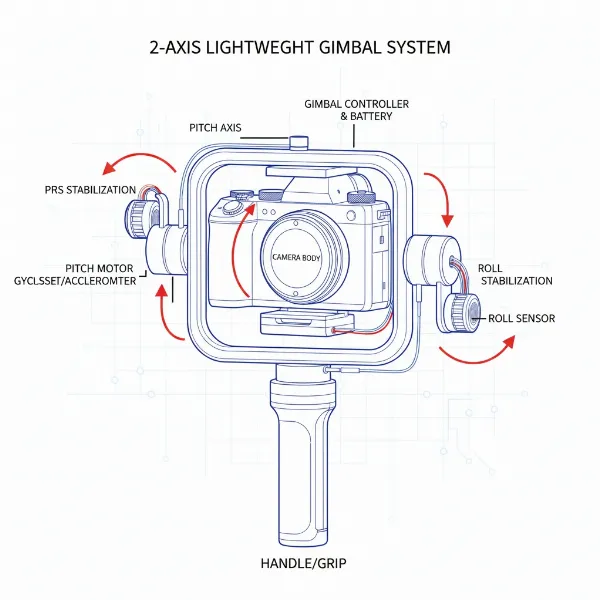 A detailed illustration of a 2-axis gimbal stabilizing camera motion along pitch and roll axes.
Delving into 3-Axis Gimbals: The Ultimate in Stabilization
A 3-axis gimbal takes stabilization a significant step further by adding a third motor dedicated to controlling the yaw (pan) axis, alongside pitch and roll. This trifecta of stabilization provides complete 360-degree control, ensuring your camera remains rock-steady regardless of movement in any direction.
The inclusion of the yaw motor means that a 3-axis gimbal can actively counteract left-to-right rotations, not just up-and-down tilts and side-to-side rolls. This comprehensive stabilization is what allows for truly cinematic and fluid motion, even in the most challenging shooting conditions.
Key Advantages of 3-Axis Gimbals
For creators seeking the highest level of stability and professional results, 3-axis gimbals are the go-to choice:
- Superior Stability and Fluidity: By compensating for all three rotational axes, 3-axis gimbals deliver exceptionally smooth, shake-free footage, even during complex movements like running, orbiting a subject, or making sharp turns.
- Cinematic Quality: This level of stabilization is essential for achieving the professional, “floating camera” look often seen in films and high-end productions.
- Wind Compensation: Especially critical for drones, a 3-axis gimbal can absorb natural drone movements caused by wind, preventing these disturbances from appearing in your final video.
- Balanced Horizon and Natural Tracking: It ensures your horizon remains level and allows for precise, stable tracking shots, whether following a subject or executing dynamic camera moves.
Ideal Use Cases for 3-Axis Gimbals
When uncompromising stability and versatility are paramount, a 3-axis gimbal shines:
- Professional Filmmaking and Videography: Essential for capturing high-quality cinematic footage, commercial advertising, and documentary filmmaking where every shot demands perfection.
- Dynamic Action and Sports: Ideal for recording fast-moving scenes, sports events, or any situation involving rapid camera or subject movement, providing fluidity where a 2-axis gimbal would struggle.
- Advanced Drone Footage: Commonly found on mid to high-end camera drones, 3-axis gimbals are a must for capturing smooth 4K HDR footage during complex flight maneuvers, AI tracking modes, and in windy conditions.
- Vlogging While Walking/Running: For active vloggers who are constantly on the move, the added yaw stabilization makes a significant difference in video smoothness.
Limitations of 3-Axis Stabilization
Despite their superior performance, 3-axis gimbals do come with a few trade-offs:
- Heavier and Bulkier: The additional motor and mechanics make 3-axis gimbals heavier and often larger than 2-axis models, which can impact portability and endurance, particularly for drones.
- More Expensive: The increased complexity and components naturally lead to a higher price point.
- Shorter Battery Life: Powering three motors typically results in shorter operating times compared to their 2-axis counterparts.
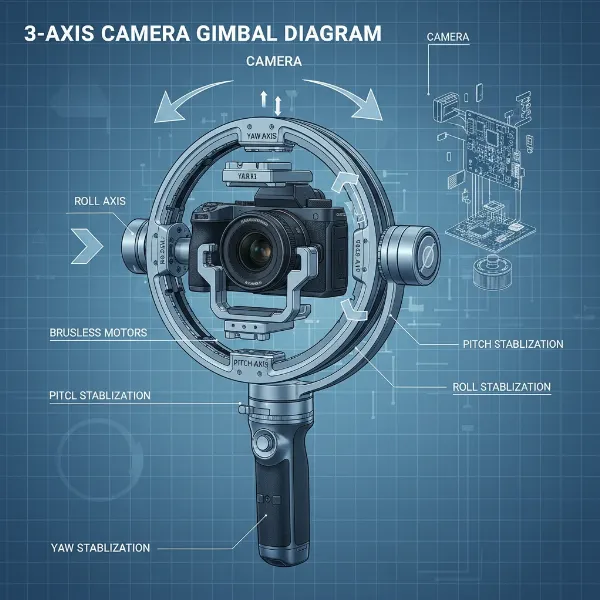 A comprehensive diagram of a 3-axis gimbal, showing stabilization across pitch, roll, and yaw axes.
Comparison Table: 2-Axis vs. 3-Axis Gimbals
To further clarify the distinctions, here’s a detailed comparison:
| Feature | 2-Axis Gimbal | 3-Axis Gimbal |
|---|---|---|
| Stabilization Axes | Pitch (Tilt), Roll | Pitch (Tilt), Roll, Yaw (Pan) |
| Weight | Lighter (typically 600-800g for handheld) | Heavier (typically 1-1.4kg for handheld) |
| Portability | Excellent | Good |
| Battery Life | Generally longer (e.g., 8-12 hours) | Generally shorter (e.g., 6-10 hours) |
| Cost |