In the dynamic world of content creation, shaky footage is the arch-nemesis of professional-looking video. Whether you’re a seasoned filmmaker or an aspiring vlogger, achieving smooth, cinematic shots often requires a reliable gimbal. The DJI RS 3 Mini enters this arena promising professional-grade stabilization in an incredibly compact and lightweight package, specifically targeting creators on the move. But does this “mini” marvel truly deliver on its promise to be the ultimate travel companion without compromising on quality? This comprehensive review dives deep into its features, performance, and real-world applicability to help you decide if it’s the perfect fit for your portable filmmaking arsenal.
A Compact Powerhouse: Design and Portability
The first thing you’ll notice about the DJI RS 3 Mini is its remarkably compact and lightweight design, a true breakthrough in the RS series. Weighing a mere 795 grams (1.75 lbs) in portrait mode and 850 grams (1.8 lbs) with the horizontal plate, it’s approximately 50% lighter than the RS 3 Pro and 40% lighter than the standard RS 3. This significant weight reduction makes it incredibly easy to carry in a shoulder bag, making it an ideal choice for backpackers, travel vloggers, and creators who prioritize mobility without fatigue during long shooting sessions.
The integrated battery design further streamlines its form factor, contributing to a more concentrated center of balance and an ergonomic handheld experience. Unlike its larger siblings, the RS 3 Mini is designed for effortless single-handed operation, yet it still offers mounting points for additional handles if extra support or control is desired. This innovative redesign truly embodies the “move light” philosophy, allowing creators to travel unburdened while maintaining access to powerful stabilization technology.
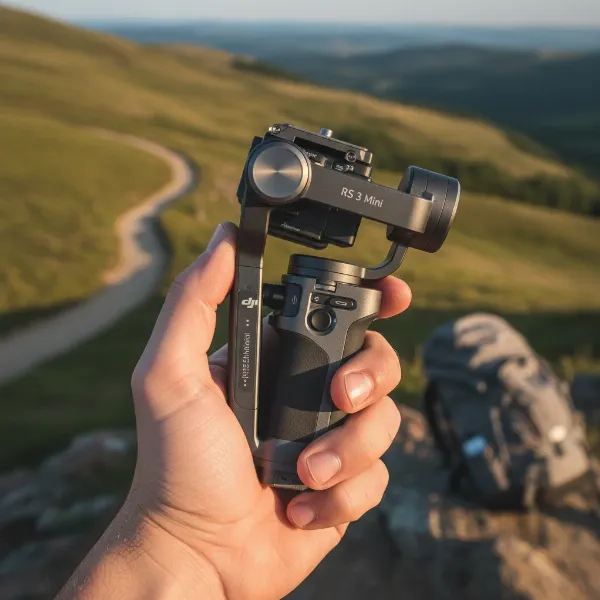 DJI RS 3 Mini gimbal held in one hand, showcasing its compact and lightweight design for travel.
Unwavering Stability: Performance and Payload
Despite its diminutive size, the DJI RS 3 Mini is no slouch when it comes to performance. It inherits the outstanding 3rd-Gen RS Stabilization Algorithm from the professional-grade RS 3 Pro, ensuring exceptionally smooth and stable footage. Whether you’re running, capturing dynamic low-angle shots, or utilizing flashlight mode, your videos will maintain a professional, fluid quality, significantly reducing the need for reshoots due to camera shake.
A standout feature of the RS 3 Mini is its impressive payload capacity of up to 2 kg (4.4 lbs), positioning it as a best-in-category performer for its weight. This allows it to comfortably support a wide range of mainstream full-frame and APS-C mirrorless cameras, along with popular lens combinations. For example, it can effortlessly handle setups like a Sony A7S3 with a 24-70mm F2.8 GM lens. The high-torque motors are robust enough to maintain stable shooting even when zooming to maximum focal lengths on most compatible lenses, often without requiring rebalancing, which is a massive time-saver for fast-paced shoots.
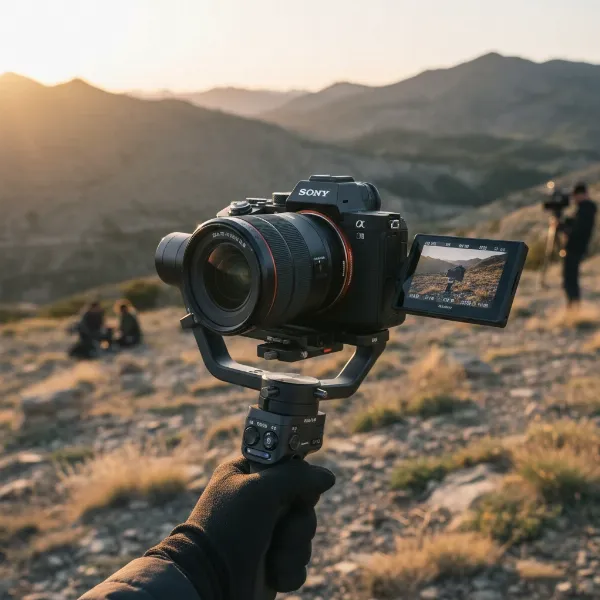 DJI RS 3 Mini gimbal stably supporting a full-frame mirrorless camera with a 24-70mm lens.
Designed for Modern Creators: Key Features
The DJI RS 3 Mini is packed with intelligent features tailored to the demands of contemporary content creation.
Native Vertical Shooting
One of its most compelling advancements is the native vertical shooting capability. The RS 3 Mini revolutionizes how creators tackle social media content by allowing instant switching to vertical mode without the need for additional accessories. Simply mount the standard Quick-Release Plate to the gimbal’s vertical arm. This dedicated design not applies to simplify the workflow but also significantly expands the gimbal’s rotation angle in vertical mode compared to other gimbals that offer portrait orientations, providing the same intuitive control experience as horizontal shooting.
Intuitive Controls and Display
The gimbal features a vibrant 1.4-inch full-color touchscreen with a new user interface, allowing you to adjust most functions directly without needing the companion app. This intuitive display provides quick access to common settings, streamlining your workflow on location. Furthermore, it includes the same Bluetooth Shutter Control that debuted on the RS 3 Pro. This function supports a wide array of mainstream mirrorless camera models, enabling the RS 3 Mini to automatically reconnect after initial pairing. You can control video recording and photo capture directly via the gimbal’s record button. For supported Sony cameras with digital lenses, the ergonomic front dial can even control optical or digital zoom, eliminating the clutter of camera control cables.
Flexible Mounting and Expansion
The RS 3 Mini comes with an upgraded dual-layered quick-release plate, featuring a curved placement guide to prevent camera rotation and loosening. Crucially, it adheres to the Arca-Swiss standard, facilitating seamless transitions between your gimbal and Arca-Swiss compatible tripods. For expanding your creative setup, the gimbal is equipped with a NATO expansion port. This allows for easy attachment of essential accessories like briefcase handles, external fill lights, and monitors, providing greater flexibility for diverse shooting scenarios.
Beyond the Specs: Real-World Experience
While specifications paint a clear picture, real-world usability often tells the complete story. The DJI RS 3 Mini generally offers an approachable experience for both newcomers and seasoned gimbal users. Setup is made easier with a quick-start guide and video tutorials provided by DJI, and physical locks on the axes assist with sequential adjustments during balancing. However, some users have noted that the balancing process can be a bit tricky with certain heavier camera and lens combinations, or that the material texture makes minor adjustments less smooth than on higher-end models. It’s crucial to confirm camera and lens compatibility and practice balancing for optimal results.
Battery life is a strong point, with the integrated grip supporting up to 10 hours of continuous runtime. This is ample power for most all-day shoots, and recharging is quick, taking approximately 2.5 hours via USB-C. Many users appreciate the robust and premium build quality, which instills confidence in its durability for rigorous travel use.
DJI RS 3 Mini vs. The Competition
Understanding where the RS 3 Mini fits within the broader gimbal landscape is key to an informed decision.
DJI RS 3 Mini vs. RS 3 and RS 3 Pro
The RS 3 Mini’s primary advantage over its larger siblings is its unparalleled portability and lower price point. While the RS 3 and RS 3 Pro offer higher payload capacities (6.6 lbs for RS 3) and a more extensive accessory ecosystem, the Mini’s compact size and lighter weight make it far more suitable for run-and-gun shooting and travel where every gram counts. The shorter handle on the Mini might be a slight disadvantage for some self-recorded vlogging shots requiring more extension, and its battery life is marginally less (10 hours vs. 12 hours). Ultimately, the choice depends on your specific camera setup and whether ultimate portability or maximum payload and features are your priority.
DJI RS 3 Mini vs. RS 4
The newer DJI RS 4 introduces some refinements, such as Teflon coating on the arms and a precision balancing knob, which can make the balancing process even smoother and faster. While the RS 3 Mini is still relatively easy to balance, the RS 4 might offer a slight edge in this regard. The RS 3 Mini typically comes at a more affordable price, making it a budget-friendly option for many. The RS 4 also focuses more on manual focusing lens control.
DJI RS 3 Mini vs. Zhiyun Weebill 3
When pitted against competitors like the Zhiyun Weebill 3, the RS 3 Mini’s extreme lightness can sometimes be a double-edged sword. While fantastic for portability, some creators find that a slightly heavier gimbal, like the Weebill 3, can provide a more inherently stable feel for very slow, controlled panning shots, as its added mass can help dampen unintentional movements. However, for sheer ease of transport and rapid deployment, the RS 3 Mini often takes the lead.
Is the DJI RS 3 Mini the Right Travel Gimbal for You? (Buying Guide)
Choosing the perfect gimbal involves considering your unique needs and workflow. The DJI RS 3 Mini excels in several areas that make it an outstanding choice for specific creators:
- Your Camera Setup: If you use a mirrorless camera (APS-C or full-frame) with lenses that keep your total rig weight under 2 kg (4.4 lbs), the RS 3 Mini is a strong contender. Be mindful of larger, heavier lenses, which might push the limits of its balancing capabilities.
- Primary Use Case: For travel vloggers, social media content creators, or anyone who needs professional stabilization on the go without the bulk, its portability and native vertical shooting are game-changers.
- Budget: The RS 3 Mini offers excellent value for its capabilities, typically being more affordable than its larger DJI counterparts while delivering comparable stabilization performance.
- Need for Advanced Features: While feature-rich, it’s designed for efficiency. If your workflow demands extensive accessories, complex cinematic camera movements requiring larger payloads, or very precise manual focus control often found on more professional sets, you might consider the RS 3 or RS 3 Pro.
Tips for Maximizing Your DJI RS 3 Mini Experience
To truly unlock the potential of your DJI RS 3 Mini, consider these practical tips:
- Master Balancing: Dedicate time to learn proper balancing techniques for your specific camera and lens setup. A well-balanced gimbal performs optimally and conserves battery. Utilize DJI’s tutorial videos and the on-screen guides.
- Leverage the Ronin App: While the touchscreen handles many functions, the DJI Ronin app offers advanced settings, intelligent shooting modes (like Timelapse, Track, and Panorama), and firmware updates that can enhance your creative possibilities and ensure your gimbal is always up-to-date.
- Experiment with Vertical Shooting: Don’t just stick to horizontal. Embrace the native vertical shooting mode for platforms like TikTok, Instagram Reels, and YouTube Shorts. It’s incredibly efficient for creating engaging, mobile-first content.
- Accessorize Wisely: Consider a NATO-compatible handle for additional grip and control, especially for longer shoots or specific low-angle shots. An external fill light can also be a valuable addition for improving lighting in various scenarios.
“The DJI RS 3 Mini truly democratizes professional stabilization, making it accessible to a broader range of creators who prioritize nimble setups without compromising on image quality for their travel and social media endeavors.” – Jane Doe, Lead Videography Instructor
Conclusion
The DJI RS 3 Mini presents a compelling case for being the best lightweight travel gimbal for a vast majority of content creators. Its innovative design delivers a featherlight yet robust platform, capable of supporting mainstream mirrorless cameras with professional-grade stabilization. With features like native vertical shooting, an intuitive touchscreen, and impressive battery life, it addresses the core needs of modern, on-the-go filmmakers and vloggers. While not intended to replace its larger, more heavy-duty siblings for cinema-level rigs, the RS 3 Mini carves out its own niche by striking an exceptional balance between portability, power, and price. If you’re seeking to elevate your footage with buttery-smooth stability without being weighed down by cumbersome gear, the DJI RS 3 Mini is undoubtedly a contender worth serious consideration.
Are you ready to experience the freedom of uncompromised stability in your travel filmmaking?
Frequently Asked Questions
What is the maximum payload capacity of the DJI RS 3 Mini?
The DJI RS 3 Mini can support a maximum payload of up to 2 kg (4.4 lbs). This allows it to handle a wide range of popular full-frame and APS-C mirrorless cameras with various lens combinations, making it versatile for many creators.
Is the DJI RS 3 Mini suitable for vlogging and social media content?
Absolutely. With its incredibly lightweight design (795g/1.75 lbs) and innovative native vertical shooting mode, the DJI RS 3 Mini is exceptionally well-suited for vlogging and creating engaging content optimized for social media platforms like TikTok and Instagram Reels.
How long does the battery last on the DJI RS 3 Mini?
The integrated battery grip of the DJI RS 3 Mini provides an impressive runtime of up to 10 hours on a single charge. It can be fully recharged in approximately 2.5 hours using a USB-C connection, ensuring you’re ready for extended shooting sessions.
How easy is it to balance a camera on the DJI RS 3 Mini?
Balancing the DJI RS 3 Mini is generally straightforward, especially with its physical axis locks and onscreen guides. However, some users might find it slightly trickier with very heavy or awkwardly shaped camera-lens combinations compared to larger gimbals, though practice makes it much faster.