In the dynamic world of smartphone videography, capturing smooth, cinematic shots can elevate your content from amateur to professional. Joby, a brand synonymous with versatile camera accessories like the GorillaPod, introduced the Spin and Swing to empower mobile creators with precise motion control. These innovative devices promise to unlock a new realm of dynamic video, timelapses, and polished B-roll footage right from your phone. But do they deliver on this ambitious promise? This review dives deep into the Joby Spin and Swing, exploring their features, performance, and crucial user experience to help you decide if they’re the right tools for your creative toolkit.
Understanding the Joby Spin and Swing: Your Mobile Filmmaking Companions
The Joby Spin and Swing are a pair of motorized motion control devices designed specifically for smartphone filmmakers. Separately, they offer distinct capabilities, but together, they form a versatile system for adding sophisticated movement to your mobile video productions. The Joby Spin is an electronic panning mount, acting as a rotating base for your smartphone or lightweight camera. It allows for smooth 360-degree panoramic sweeps and precise rotational movements ideal for captivating timelapses or slow, dramatic reveals. Its counterpart, the Joby Swing, is a compact, electronic slider that provides linear tracking shots. With its unique “scissor-like” design, it delivers smooth push-in or pull-out movements, mimicking the action of a professional camera dolly. Both devices connect via Bluetooth to the Joby Motion app, giving you digital control over their movements, speed, and sequencing.
These accessories are crafted to be highly portable and lightweight, making them perfect companions for creators on the go. Whether you’re a vlogger seeking to add production value, a social media content creator looking for standout visuals, or an aspiring filmmaker experimenting with motion, the Spin and Swing aim to provide professional-grade results from your pocket-sized studio. They represent an intriguing step forward for smartphone content creation, promising to transform static shots into dynamic visual narratives with relative ease.
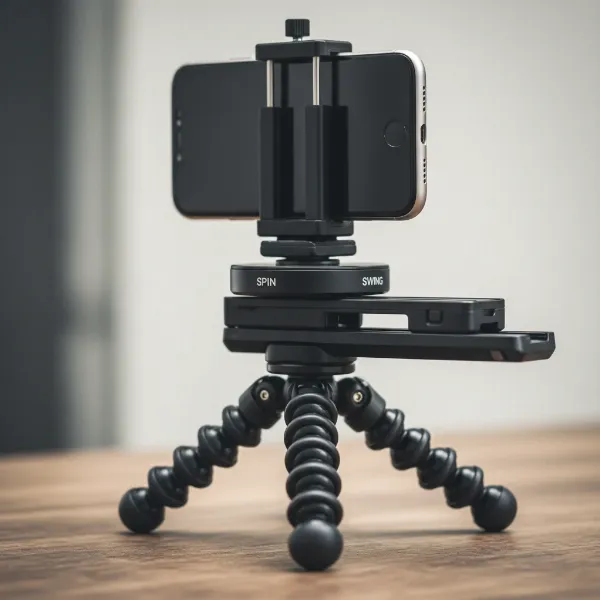 Joby Spin and Swing devices for smartphone motion control, on a tripod with a phone.
Key Features and Design Innovations
The Joby Spin and Swing are engineered with thoughtful features tailored for mobile content creation. The Joby Spin excels in its ability to execute incredibly smooth, app-controlled pans. It offers a full 360 degrees of rotation, allowing for sweeping panoramas, precise point-to-point movements, and dynamic rotational timelapses. Users can adjust the speed of the pan, and the device is designed to incorporate “ease in” and “ease out” functionality, ensuring that movements start and stop gradually, much like a professional camera operator would achieve. It’s a pocket-sized powerhouse, capable of supporting devices up to 1.7 lbs, making it suitable for most smartphones with additional mounts or even small action cameras.
The Joby Swing, on the other hand, specializes in linear motion. Its ingenious split-arm, scissor-like mechanism allows it to extend and retract, providing up to 15 inches (380mm) of tracking distance. This functionality enables creators to achieve dramatic slider shots, smoothly pushing into a subject or pulling back to reveal a wider scene. Both devices feature a standard 1/4″-20 tripod mount on the bottom for easy attachment to tripods or other supports, and a 1/4″-20 screw on top for securing phone mounts or lightweight cameras. They are built with robust materials like polycarbonate PC and steel, ensuring durability, and are powered by internal lithium batteries rechargeable via USB-C, offering around 3 hours of battery life for video (Spin) and 1.5 hours (Swing). Additionally, a built-in spirit level on both units helps ensure your shots are perfectly level.
| Feature | Joby Spin (Panning) | Joby Swing (Sliding) |
|---|---|---|
| Motion Type | 360° Panning | Linear Sliding |
| Travel Distance | N/A (Rotation) | Up to 15 inches (380mm) |
| Control Method | Bluetooth (Joby Motion App) | Bluetooth (Joby Motion App) |
| Connectivity | Bluetooth 5.1 | Bluetooth 5.1 |
| Max Load | 1.7 lbs (0.77 kg) | 1.32 lbs (0.6 kg) |
| Battery Life (Video) | 3 hours | 1.5 hours |
| Charging | USB-C | USB-C |
| Mounting | 1/4″-20 Thread (Top & Bottom) | 1/4″-20 Thread (Top & Bottom) |
| Portability | Compact, Lightweight | Compact, Lightweight |
Performance and User Experience: A Tale of Two Halves
Setting up the Joby Spin and Swing individually is generally straightforward. Both devices are designed to be intuitive: attach your smartphone (using a GripTight mount or similar), mount the Joby unit to a tripod, and connect via Bluetooth to the Joby Motion app. The physical hardware itself feels sturdy and well-constructed, embodying Joby’s reputation for quality accessories. When the devices perform as intended, the motion they produce is impressively smooth and consistent, particularly the panning on the Spin and the linear tracking on the Swing. For capturing captivating timelapses or adding subtle, professional movement to B-roll, their potential is evident. The ability to program start and end points for motion sequences is a powerful feature, allowing for repeatable and precise shots.
However, the overall user experience often falls short of the hardware’s promise, largely due to a single, critical component: the Joby Motion app. While the concept of app-driven motion control is modern and appealing, the execution of the app has been a significant point of contention for many users. The app is tasked with programming intricate motions, controlling speeds, and facilitating features like timelapses and panoramic photos. Yet, reviews frequently describe it as clunky, unintuitive, and prone to crashes. This inconsistent software performance directly impacts the reliability and enjoyment of using the Spin and Swing. Learning to navigate the app can be a fiddly process, and inconsistent connections or unexpected glitches can disrupt a carefully planned shot, leading to frustration. For devices that rely entirely on software for their core functionality, a subpar app experience undermines the entire product.
“The Joby Spin and Swing offer incredible potential for smartphone videography, but their success hinges entirely on the Joby Motion app. Without a seamless software experience, even the best hardware can fall flat.”
Pros and Cons: Weighing the Motion Control Benefits
Understanding the strengths and weaknesses of the Joby Spin and Swing is crucial for prospective buyers. While they introduce innovative motion control capabilities to smartphone filmmaking, they also come with a set of limitations that must be considered.
Pros:
- Compact and Portable Design: Both the Spin and Swing are small, lightweight, and easy to carry, making them ideal for on-the-go content creators.
- Smooth Motorized Motion: When functioning correctly, the devices deliver impressive, consistent panning and sliding motions, enhancing video quality significantly.
- Dedicated Smartphone Solution: Designed specifically for mobile devices, offering features tailored to phone cameras and workflows.
- Innovative Concept: The idea of affordable, app-controlled motion for phones is highly appealing for many creators.
- Versatility: The Spin can pan 360 degrees, while the Swing provides up to 15 inches of linear tracking, offering diverse shot possibilities.
- Quality Construction: The physical units are generally well-built and sturdy.
Cons:
- App Reliability Issues: The Joby Motion app is frequently criticized for being clunky, difficult to use, prone to crashes, and lacking intuitive controls. This is the most significant drawback.
- Fiddly Setup: Achieving precise and repeatable shots can require considerable practice and patience due to app complexities.
- Inconsistent Performance: Some users report occasional stuttering in the Swing’s motion, which can ruin shots.
- Limited Speed Options: The range of speed control within the app may not be extensive enough for all creative needs.
- Smartphone-Only: Not compatible with heavier DSLR or mirrorless cameras, limiting their utility for some creators.
- Dependency on Tripod: Requires a stable tripod for optimal use, adding to the overall setup.
Comparison with Alternatives: Where Do They Stand?
In the realm of motion control for phones, the Joby Spin and Swing face a varied landscape of alternatives, ranging from simple mechanical solutions to more advanced electronic gimbals. Basic alternatives, such as clockwork panning tripods like the Veho Muvi X-Lapse, offer limited, single-speed rotation for timelapses but lack the precision and app control of the Spin. These simpler options are often more affordable but come with significant functional limitations.
For more sophisticated motion control, professional-grade systems like those from Edelkrone set a high bar for app quality and robust performance. While these solutions are often more expensive and designed for larger cameras, their intuitive software interfaces serve as a benchmark for what mobile motion control apps should aspire to be. Smartphone gimbals, such as those from DJI Osmo Mobile or Zhiyun Smooth series, offer excellent stabilization and some motion control features (like tracking and panoramic modes) but are primarily designed for handheld use and don’t provide the dedicated linear sliding or continuous panning capabilities of the Spin and Swing. The unique selling proposition of the Joby Spin and Swing lies in their specialized focus on adding app-controlled panning and sliding motion to phones in a compact form factor. However, the glaring contrast in app experience between Joby’s offering and the smoother, more reliable software found in competitors or even higher-end professional tools is a critical differentiator.
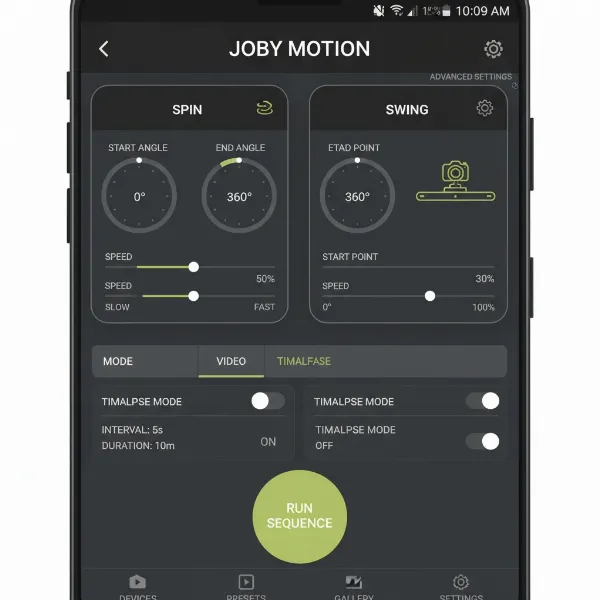 Joby Motion app interface showing controls for Spin and Swing devices.
Who Should Consider (or Avoid) the Joby Spin and Swing?
The Joby Spin and Swing are intriguing pieces of kit, but they are not for everyone.
You should consider the Joby Spin and Swing if:
- You are a smartphone videography enthusiast eager to experiment with adding dynamic motion to your videos and timelapses, and you have patience for learning and troubleshooting.
- You prioritize portability and compact design above all else for your mobile filming accessories.
- You are willing to invest time in mastering the nuances of the Joby Motion app and working around its current limitations.
- You primarily shoot B-roll or timelapses where repeatable, smooth motion can significantly elevate your content.
You should probably avoid the Joby Spin and Swing if:
- You are a professional content creator who relies on perfectly consistent and reliable equipment for client work or high-stakes projects.
- You expect a seamless and intuitive user experience right out of the box, without software frustrations.
- You need motion control for DSLR or mirrorless cameras, as these devices are exclusively for smartphones.
- You are on a tight deadline and cannot afford to spend time troubleshooting app glitches or re-shooting due to inconsistent motion.
- Your primary need is stabilization for handheld video, in which case a traditional smartphone gimbal would be a more suitable choice.
Conclusion: Promising Potential, App-Driven Reality
The Joby Spin and Swing present an exciting vision for enhancing smartphone videography with sophisticated motion control. Their compact design, robust build, and specialized panning and sliding capabilities offer undeniable potential for creators looking to add a professional touch to their mobile content. Imagine effortlessly smooth 360-degree pans or cinematic tracking shots, all controlled from your phone.
However, this promising potential is significantly tempered by the current state of the Joby Motion app. While the hardware impresses, the software, which is the brain of the operation, often falls short, leading to frustration, inconsistent performance, and a steeper learning curve than necessary. For a product category that relies so heavily on seamless software integration, the app’s shortcomings become the devices’ most substantial challenge. If Joby can refine and improve the app to match the quality of its hardware, the Spin and Swing could truly become indispensable tools for mobile filmmakers.
Are you willing to navigate the app’s current limitations to unlock the creative motion these devices offer, or will you wait for a more polished software experience?
Frequently Asked Questions
What kind of shots can Joby Spin and Swing create?
The Joby Spin specializes in smooth 360-degree panning shots and rotational timelapses, while the Joby Swing delivers linear tracking movements, simulating a camera slider or dolly. Together, they enable dynamic B-roll, revealing shots, and creative timelapses with your smartphone.
Is the Joby Motion app easy to use?
Many users find the Joby Motion app to be a significant drawback. It is often described as clunky, unintuitive, and sometimes prone to crashes, which can make programming motion sequences and achieving desired results more challenging than expected.
Are the Joby Spin and Swing compatible with DSLR/mirrorless cameras?
No, the Joby Spin and Swing are designed exclusively for smartphones. While they feature standard 1/4″-20 mounts, their load capacity and overall design are optimized for the lighter weight and specific needs of mobile devices, not heavier cameras.
How long do the batteries last?
The Joby Spin offers approximately 3 hours of battery life for video recording, while the Joby Swing provides about 1.5 hours. Both devices are rechargeable via a USB-C connection, with a full charging time of about 2.5 hours.
Can the Spin and Swing work together for multi-axis motion?
Yes, the Joby system includes an optional Pan/Tilt bracket that allows two Joby Spin units to be combined for 2-axis (pan and tilt) motion control. This setup can create even more complex and dynamic shots for advanced mobile filmmakers.