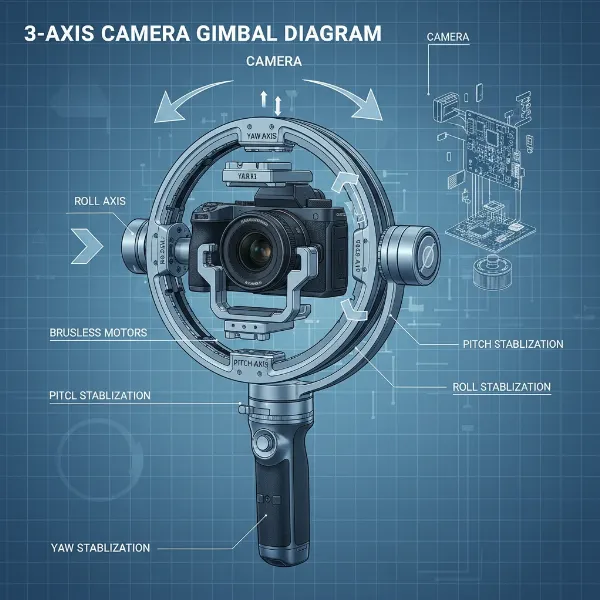
In the dynamic world of videography and filmmaking, achieving buttery-smooth footage is paramount. For years, bulky gimbals reigned supreme as the go-to solution for eliminating camera shake. However, with the rapid evolution of in-camera stabilization technologies like In-Body Image Stabilization (IBIS), many creators are asking: Is the era of the external gimbal drawing to a close? This isn’t just a technical debate; it’s a critical question influencing gear choices, shooting styles, and ultimately, the visual quality of countless productions. Understanding the nuances of these stabilization methods is key to navigating the future of stable video.
Understanding Camera Stabilization Technologies
Before we can look to the future, it’s essential to grasp the fundamental ways cameras achieve stability today. Modern cameras employ several sophisticated methods to combat unwanted motion, each with its unique strengths and mechanisms.
In-Body Image Stabilization (IBIS)
IBIS is a technological marvel built directly into the camera body. It works by detecting camera movements and shifting the camera’s sensor along multiple axes to counteract those movements, keeping the image stable on the sensor. The primary benefit of IBIS is its versatility; it works with virtually any lens attached to the camera, including older, non-stabilized optics, making it a cost-effective solution for many photographers and videographers. For subtle handheld movements or when shooting from a static position, IBIS provides impressive stability without adding external bulk.
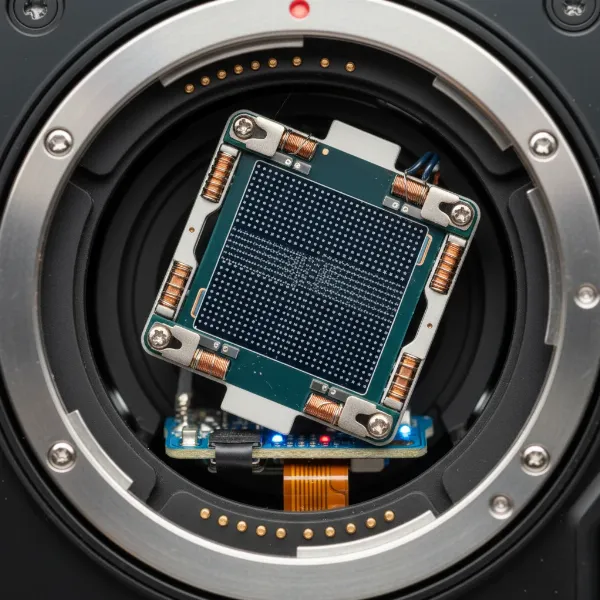 Close-up of a camera sensor moving to counteract shake for in-body image stabilization.
Optical Image Stabilization (OIS)
OIS, or lens-based stabilization, operates within specific lenses. It uses a floating lens element that moves to compensate for vibrations, ensuring the light reaching the sensor remains steady. Often found in telephoto lenses where even minor shakes are greatly magnified, OIS is highly effective at its intended task. Many modern camera systems combine IBIS with OIS (sometimes called “hybrid stabilization”) to achieve even greater levels of shake reduction, offering the best of both worlds.
Electronic Image Stabilization (EIS)
Electronic Image Stabilization is a software-based solution, predominantly found in smartphones and action cameras. EIS analyzes video frames in real-time or during post-processing, digitally shifting and cropping the image to smooth out motion. While convenient and requiring no additional hardware, EIS typically comes with a crop factor, meaning it slightly reduces your field of view and can sometimes introduce minor distortion or a “jello” effect, especially with aggressive movements.
The Enduring Power of Gimbals
Despite the remarkable advancements in in-camera stabilization, gimbals continue to hold a crucial position in the videographer’s toolkit. These motorized stabilizers use gyroscopes and brushless motors to physically isolate the camera from the operator’s movements, providing a level of fluidity that in-camera systems often struggle to match.
Gimbals excel in dynamic shooting scenarios where the camera is constantly in motion. Imagine tracking a subject running, executing a complex crane shot, or achieving a smooth cinematic pan – gimbals deliver unparalleled stability and control. They effectively eliminate shake across all three axes (pan, tilt, and roll), making footage appear as if it were shot on rails. Furthermore, many modern gimbals offer intelligent features such as active tracking, pre-programmed motion time-lapses, and dedicated controls for focus and zoom, significantly expanding creative possibilities. Gimbals also allow for slower shutter speeds in low-light conditions by reducing shake, capturing brighter and smoother footage.
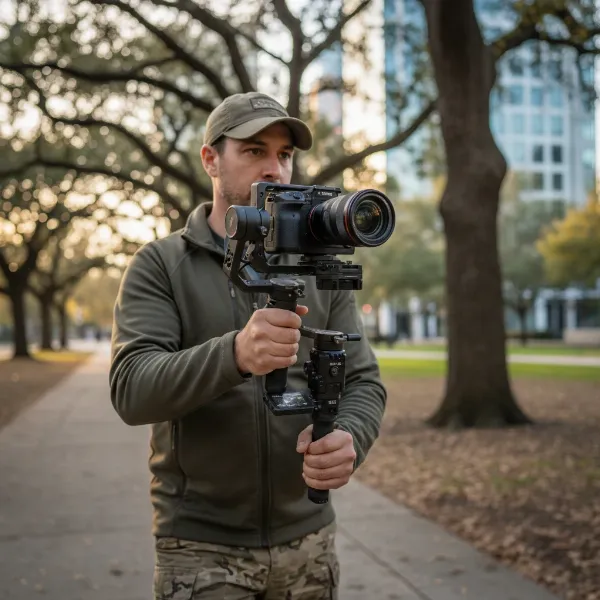 Professional videographer operating a camera on a motorized gimbal for smooth, cinematic footage.
Comparing the Two: When to Choose What
The question isn’t necessarily which is “better,” but rather which tool is appropriate for the task at hand. Both in-camera stabilization and gimbals have distinct strengths and limitations that cater to different shooting styles and production needs.
In-Camera Stabilization (IBIS/OIS/EIS) Strengths
- Portability & Convenience: Integrated into the camera, there’s no extra gear to carry, set up, or balance. This makes it ideal for run-and-gun shooting, travel, or situations where a minimal footprint is desired.
- Always On: IBIS is always active with any compatible lens, providing baseline stability for general handheld photography and video.
- Cost-Effective: If your camera already has good IBIS, you avoid the additional investment in a gimbal.
- Subtle Movements: Excellent for reducing minor hand jitters when stationary or performing slow, deliberate movements.
Gimbal Strengths
- Superior Smoothness: For complex tracking shots, walking, running, or any significant camera movement, gimbals provide a level of cinematic smoothness that even the best IBIS systems cannot replicate.
- Greater Range of Motion: Gimbals can compensate for much larger movements and oscillations than in-camera systems.
- Handles Heavier Rigs: Can stabilize larger cameras, heavy lenses, and accessories that would overwhelm an IBIS system.
- Creative Control: Many gimbals offer advanced modes for precise control over camera movement, active subject tracking, and unique shot angles.
- Low-Light Advantage: By reducing shake, gimbals allow for slower shutter speeds, which can improve low-light performance by capturing more light without introducing motion blur.
Limitations of IBIS
While powerful, IBIS isn’t a silver bullet. Its effectiveness can diminish with longer telephoto lenses, where the sensor’s compensatory movement range becomes insufficient for magnified shakes. Fast-paced scenes with rapid movement can also expose IBIS’s limitations, potentially leading to less smooth results or even “micro jittering” if the system overcorrects. Additionally, continuous use of IBIS, especially during long takes, can consume more battery power and potentially lead to camera overheating.
Limitations of Gimbals
Gimbals come with their own set of compromises. They add significant bulk and weight to a camera setup, requiring more effort to transport and operate. Setup and balancing can be time-consuming, especially for photographers who frequently change lenses. Gimbals also represent an additional investment, and require operational skill to master for truly fluid shots. Some users also find that gimbals can restrict creative spontaneity compared to the freedom of handheld shooting.
The Hybrid Approach: Working Together
Instead of an “either/or” scenario, the future of stabilization increasingly points towards a “both/and” approach. Many professionals now integrate both in-camera stabilization and gimbals into their workflows, leveraging the unique strengths of each. For instance, IBIS can be used for subtle, handheld shots, while a gimbal is deployed for more complex, dynamic sequences.
Interestingly, using IBIS and a gimbal simultaneously isn’t always straightforward. Some sources suggest that IBIS can sometimes overcompensate for the gimbal’s movements, leading to a less desirable “weird” or “floaty” look. Therefore, it’s often recommended to test or even disable IBIS when operating a camera on a gimbal, or to adjust settings to find the optimal combination. The emergence of “hybrid camera stabilizers” that combine mechanical and electronic stabilization further blurs the lines, offering multi-axis stability by combining physical design with electronic fine-tuning.
Future Trends in Stabilization
The journey of stabilization technology is far from over. We can expect exciting innovations in the coming years:
- AI and Machine Learning: Artificial intelligence will play an increasing role in predicting and compensating for camera movements, leading to even more intelligent and adaptable stabilization systems.
- Advanced Sensor-Shift Technology: Innovations like Nikon’s Focus-Point VR, which centers stabilization around the autofocus point rather than the sensor’s center, signify a move towards more precise and effective in-body systems.
- Miniaturization and Integration: As technology advances, we might see even more compact and lightweight gimbals, or cameras with integrated gimbal-like stabilization mechanisms that minimize bulk without compromising performance.
- Computational Videography: Enhanced in-camera processing and post-production software will continue to improve digital stabilization, potentially offering gimbal-like results with less physical gear, though often still with compromises like cropping.
Conclusion
The question of whether cameras will replace gimbals is not a simple yes or no. While in-camera stabilization has made incredible strides, providing unprecedented stability for everyday shooting and run-and-gun scenarios, gimbals retain their crown for achieving truly cinematic, dynamic motion. They are different tools, each excelling in distinct situations.
The future of stabilization is likely one of convergence and specialization, where both technologies continue to evolve, offering creators a diverse array of options. Instead of a replacement, envision a future where these tools complement each other, empowering filmmakers to achieve their creative visions with greater flexibility and precision than ever before. So, will gimbals disappear? Unlikely, but their role, much like the technology itself, is continuously transforming.
What kind of stable footage are you trying to capture in your next project?
Frequently Asked Questions
Do I still need a gimbal if my camera has excellent IBIS?
For general handheld shooting, static shots, and subtle movements, excellent IBIS can often suffice, allowing you to travel lighter and set up faster. However, for highly dynamic movements, professional tracking shots, or aggressive camera work like running, a gimbal typically provides a superior, more fluid result that IBIS alone cannot fully replicate.
What are the main drawbacks of relying solely on in-camera stabilization for video?
While convenient, in-camera stabilization can struggle with very long telephoto lenses and rapid, complex movements, sometimes producing less smooth footage or artifacts. It can also lead to increased battery drain and potential overheating during extended shoots.
Can I use my camera’s IBIS with a gimbal?
It depends on the camera and gimbal. In some cases, using both can lead to overcorrection and undesirable “jello” effects. Many professionals choose to disable or adjust their camera’s IBIS settings when using a gimbal to ensure the external stabilizer performs optimally. It’s always best to test your specific setup.
How do gimbals improve low-light video?
Gimbals reduce camera shake significantly, allowing you to use slower shutter speeds without blurring your image. Slower shutter speeds capture more light, which results in brighter and smoother footage in challenging low-light environments.