The world of filmmaking is constantly evolving, with new technologies promising to push the boundaries of visual storytelling. For decades, achieving buttery-smooth, dynamic camera movements often required extensive rigging, large crews, and significant budgets. Then came the DJI Ronin 4D, a groundbreaking cinema camera that integrates imaging, stabilization, and focusing into a single, compact system. But does this all-in-one marvel truly represent the future of cinematography, or is it a specialized tool best suited for a specific niche? This comprehensive review delves into the Ronin 4D’s capabilities, innovations, and limitations to answer that pivotal question for modern filmmakers.
The Integrated Powerhouse: What is the DJI Ronin 4D?
At its core, the DJI Ronin 4D is an ambitious reimagining of the cinema camera. Unlike traditional setups that piece together separate cameras, gimbals, and focus systems, the Ronin 4D unifies these elements into a highly integrated design. This means faster setup times and a more streamlined workflow, allowing filmmakers to focus more on creative execution rather than technical assembly.
The system features DJI’s Zenmuse X9 full-frame camera, available in both 6K and 8K configurations. This choice provides cinematographers with high-resolution capture capabilities, essential for modern production demands. By combining a professional-grade camera with an advanced stabilization system and intelligent focusing, DJI aims to deliver a complete cinematography solution right out of the box, promising a level of convenience and performance previously unattainable in a single unit.
Unparalleled Stabilization: The 4-Axis Advantage
One of the Ronin 4D’s most touted features is its advanced 4-axis stabilization system. This goes beyond a conventional 3-axis gimbal by incorporating a Z-axis arm, which actively compensates for vertical camera shake. The result is exceptionally smooth footage, even when the camera operator is walking, running, or navigating challenging terrain.
This innovative stabilization effectively eliminates much of the vertical bobbing and swaying that often plagues handheld shots or even footage from traditional gimbals. For solo filmmakers or small crews tackling dynamic scenes, the 4-axis system can deliver cinematic movement that might otherwise require complex dolly tracks, cranes, or Steadicam operators. It redefines what’s possible for fluid, controlled camera motion in a portable package, opening up new creative avenues for various genres, from documentaries to action sequences.
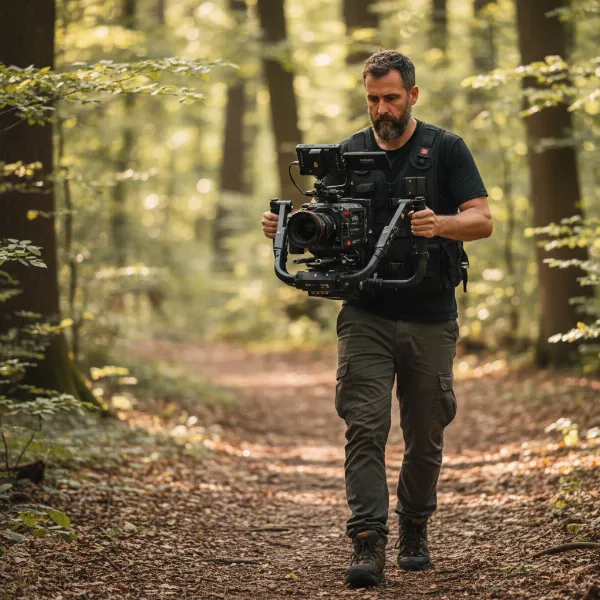 A cinematographer operating a DJI Ronin 4D, showcasing its 4-axis stabilization system in action, moving smoothly through a dynamic outdoor scene.
Precision and Control: LiDAR Focusing & ActiveTrack Pro
The DJI Ronin 4D distinguishes itself with its sophisticated LiDAR (Light Detection and Ranging) focusing system. This technology emits thousands of laser points to create a precise depth map of the scene, enabling incredibly fast and accurate autofocus, even in low-light conditions. It revolutionizes focusing, providing reliable tracking and seamless transitions between subjects.
For solo cinematographers, the LiDAR system, combined with ActiveTrack Pro, becomes a powerful ally. ActiveTrack Pro intelligently identifies, frames, and tracks subjects, allowing the operator to maintain focus on their movement without constantly adjusting focus manually. This capability frees up the filmmaker to concentrate on composition and camera movement, knowing that focus will remain sharp. While remarkably effective, it’s worth noting that optimal LiDAR performance is often achieved with DJI’s native DL-mount lenses, though adapters allow for a broader range of third-party lenses with varying degrees of LiDAR assistance.
Cinematic Image Quality: Sensor, Resolution, and Dynamic Range
At the heart of the Ronin 4D’s cinematic appeal is its full-frame Zenmuse X9 sensor, capable of recording in stunning 6K or 8K resolutions. This sensor captures rich detail and exhibits impressive color accuracy, delivering images that grade beautifully in post-production. The camera supports high-quality codecs like Apple ProRes RAW, ProRes 422 HQ, and H.264, providing flexibility for different production workflows and storage needs.
The Ronin 4D also boasts a wide dynamic range, often cited at 14+ stops, which allows it to retain detail in both bright highlights and deep shadows. Its dual native ISO (e.g., 800/4000 for the 6K model) ensures excellent low-light performance, making it a surprisingly strong contender against established “low-light monsters” in the market. Furthermore, the integrated 9-stop mechanical ND filter system is a game-changer, offering quick and seamless exposure control without needing external filters. However, a known limitation is its electronic rolling shutter, which can introduce distortion with very fast camera movements or quickly moving subjects, a trade-off for its high-resolution sensor.
Ergonomics and Workflow: Designed for the Modern Filmmaker
The Ronin 4D’s integrated and modular design philosophy is a significant departure from traditional cinema camera rigs. It’s engineered for quick deployment, minimizing the time-consuming setup often associated with professional camera systems. The camera body, constructed from carbon fiber and aluminum-magnesium alloy, is robust yet ergonomically designed for comfortable handheld operation.
A standout feature is the high-bright, 5.5-inch 1000-nit touchscreen monitor, offering excellent visibility even in direct sunlight. This monitor provides intuitive access to camera settings, focus controls, and playback. Power is centralized through a single TB50 intelligent battery, simplifying power management across the entire system. For remote operation, the O3 Pro wireless video transmission system delivers a stable 1080p/60fps feed over vast distances, enhancing collaborative shooting on set. While DJI offers its own DL-mount lenses and proprietary PROSSD storage, adapters and external SSD options provide some flexibility for cinematographers with existing gear.
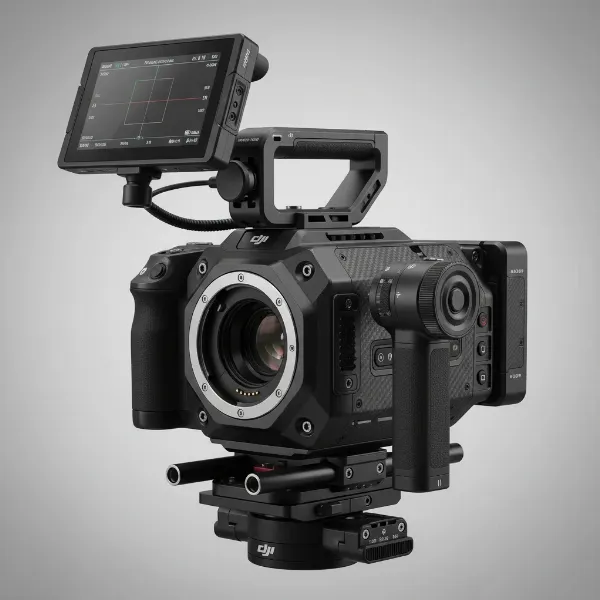 A detailed shot of the DJI Ronin 4D's modular design, highlighting its various integrated components like the monitor, grips, and lens mount.
DJI Ronin 4D vs. The Competition: Where Does It Stand?
Comparing the DJI Ronin 4D to other cinema cameras reveals its unique position in the market. Traditional systems from manufacturers like ARRI, RED, or Sony (e.g., FX6/FX9) typically favor a highly modular approach, allowing cinematographers to choose separate cameras, gimbals, lenses, and accessories. This offers immense customization but often at the cost of complexity, setup time, and overall weight.
The Ronin 4D, with its all-in-one integration, streamlines the shooting process, making it particularly appealing for solo operators, documentary filmmakers, and fast-paced productions where efficiency is paramount. While some veteran cinematographers accustomed to the specific color science and extensive lens ecosystems of ARRI or RED might initially view the Ronin 4D as a “niche” tool, its image quality, stabilization, and LiDAR focusing are undeniably competitive at its price point. It’s not designed to replace every cinema camera on every set, but rather to excel in scenarios where its integrated strengths offer a clear advantage, sometimes serving effectively as a B-cam on larger productions.
> “The DJI Ronin 4D represents a significant leap for independent filmmakers, allowing for previously complex camera movements without the need for a massive crew or heavy rigging.” – Rachel Morrison, ASC, Cinematographer
Is the DJI Ronin 4D the Future of Cinematography?
The question of whether the DJI Ronin 4D truly embodies the “future of cinematography” is complex. It’s undeniably a pioneering device, creating a new product category by seamlessly merging several critical filmmaking tools. For many, especially those operating with smaller crews or demanding dynamic, stabilized footage in challenging environments, the Ronin 4D is transformative. It empowers creators to achieve cinematic results with greater efficiency and fewer logistical hurdles.
However, the “future” is rarely a singular path. While the Ronin 4D excels in its integrated capabilities, some traditional aspects, such as its rolling shutter, proprietary ecosystem elements (lenses, batteries, storage), and the specific “look” of its image, might not align with every high-end production’s requirements or established workflows. It’s more accurate to say that the DJI Ronin 4D represents a significant future for cinematography – one focused on integration, intelligent automation, and streamlined solo operation. It expands the toolkit available to filmmakers, enabling new creative possibilities and democratizing access to complex camera movements. As a first-generation product, its evolution will undoubtedly continue to shape the industry.
Conclusion
The DJI Ronin 4D stands as a testament to innovation in filmmaking technology, offering an unprecedented blend of a full-frame cinema camera, advanced 4-axis stabilization, and intelligent LiDAR focusing in a single, integrated unit. Its ability to deliver consistently smooth, high-quality footage with remarkable ease-of-use positions it as a powerful asset for solo operators and small production teams looking to elevate their cinematic output. While it presents some considerations regarding its proprietary ecosystem and rolling shutter, the Ronin 4D has undeniably carved out a unique and influential space in the industry. It simplifies complex shots, accelerates workflows, and expands creative possibilities, proving itself not just as a cutting-edge tool, but as a compelling vision for a more agile and integrated future in cinematography. What innovations will define the next generation of cinema cameras? Only time will tell, but the Ronin 4D has certainly set a high bar.
Frequently Asked Questions
What resolutions can the DJI Ronin 4D record?
|
Our Picks for the Best Washing Machine in 2026
As an Amazon Associate I earn from qualifying purchases.
|
||
| Num | Product | Action |
|---|---|---|
| 1 | Giantex Portable Washing Machine, 21lbs Capacity, 14.4lbs Washer and 6.6Llbs Spinner, Compact for Apartment RV, White & Gray, GT-GE-10390US-GR-FP |

|
| 2 | COSTWAY Portable Washing Machine, Twin Tub 26lbs Capacity Laundry, 18lbs Washer and 8lbs Spinner Combo with Timer Knobs, Built-in Drain Pump, Compact Washer for Home Dorm Apartment (Grey+White) |
|
| 3 | COSTWAY Portable Washing Machine, Twin Tub 26 Lbs Capacity, 18 Lbs Washer and 8 Lbs Spinner, Compact Washer with Control Knobs, Timer Function, Drain Pump, Laundry washer for Apartment RV, Blue |
|
| 4 | Giantex Portable Washing Machine, 17.6lbs Compact Washer Spinner Combo with Pump Drain, Twin Tub 11lbs Wash & 6.6lbs Spin, Lavadoras Portatiles for Apartment RV Dorm College (White & Blue) |
|
| 5 | Waterjoy Portable Washing Machines, 7.7 lbs Load Capacity Portable Washer and Dryer Combo with Built-in Barrel Light & LED Display for Household and Apartment (Blue) |
|
| 6 | Portable Washing Machine,16L Upgraded Large Capacity Portable Washer With 3 Modes Deep Cleaning.Suitable For Travel, Camping,Apartments, Dormitories, Hotels (Green) |
|
| 7 | Giantex Portable Washing Machine, 20lbs Capacity, Twin Tub 2lbs Washer & 8lbs Spinner Combo, Compact for Apartment RV Dorms, Blue & White, GT24267-PE |
|
| 8 | Portable Washing Machine - Compact 2.0 Cu.ft Portable Washer, Full-Automatic Top Loader for Space Saving, Ideal for Apartments, Homes, and Dorms, 10 Wash Cycles, Low Noise, IPX4 with Drain Pump |
|
| 9 | Avanti Portable Compact Washing Machine for Clothes/Laundry, 0.84 Cu. Ft. Capacity, Standard Sink/Faucet Attachment for Apartment, Dorm, RV, White |
|
| 10 | COSTWAY Portable Washing Machine, Twin Tub 26lbs Capacity Laundry Washer, 18lbs Washer and 8lbs Spinner Combo with Timer Knobs, Built-in Drain Pump, Compact Washer for Home Dorm Apartment, Blue+White |
|
The DJI Ronin 4D is available with either a 6K or 8K Zenmuse X9 full-frame sensor. It can record in resolutions up to 6008×3168 at 60fps (6K model) or 8K at 75fps (8K model), utilizing codecs like Apple ProRes RAW, ProRes 422 HQ, and H.264.
Does the DJI Ronin 4D have good low-light performance?
Yes, the DJI Ronin 4D is praised for its impressive low-light performance. Equipped with dual native ISO (e.g., 800/4000 for 6K, 800/5000 for 8K), it maintains clean images and a wide dynamic range even in challenging lighting conditions, making it a strong performer for shooting in dimly lit environments.
Can I use third-party lenses with the DJI Ronin 4D?
The DJI Ronin 4D features a native DL mount, but it also supports other lens mounts such as Sony E-mount, Leica M-mount, and others via adapters. While third-party lenses can be used, optimal performance, especially for the LiDAR focusing system, is typically achieved with native DL lenses.
What are the main advantages of the 4-axis stabilization?
The 4-axis stabilization system, combining a traditional 3-axis gimbal with a Z-axis arm, offers superior vertical stability. This allows for incredibly smooth handheld footage, effectively eliminating vertical bounce and shake, and enabling dynamic camera movements that would be challenging or impossible with conventional stabilization systems.
Is the DJI Ronin 4D suitable for professional Hollywood productions?
While the DJI Ronin 4D has been used as a B-cam or for specific dynamic shots in some high-end productions, its “all-in-one” nature and proprietary ecosystem can be a departure from the highly modular, established workflows of traditional Hollywood sets. It excels particularly for productions seeking efficiency, advanced stabilization, and integrated features without a massive crew.