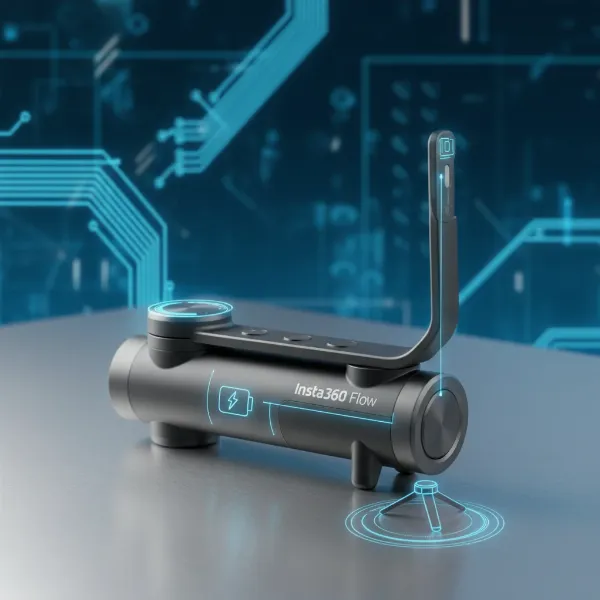
The dynamic world of videography demands versatility and precision, pushing creators to capture compelling shots from every conceivable angle. Modern camera gimbals are essential tools in achieving this, offering unparalleled stability. However, truly mastering these devices often requires a deep understanding of their various operational configurations. Among the most discussed are “Sling Mode” and “Underslung Mode,” two concepts that, while related, serve distinct purposes in enhancing a filmmaker’s creative and ergonomic capabilities. Recognizing their unique characteristics and applications is key to unlocking the full potential of your camera stabilizer.
What is Underslung Mode?
Underslung mode refers to a specific operational posture where a camera gimbal and its attached camera are inverted or held below the operator’s primary grip or support system. Instead of the camera resting above the motors and handle in a conventional upright position, it is positioned beneath, often hanging low, close to the ground. This configuration fundamentally alters the gimbal’s center of gravity and allows for a unique range of motion and shot types.
The primary purpose of underslung mode is to facilitate extremely low-angle shots, providing perspectives that are otherwise challenging or impossible to achieve with a standard gimbal setup. Imagine tracking a character’s feet, capturing a child’s eye-level view, or smoothly gliding just above a surface. This mode excels in such scenarios, offering an immersive, ground-hugging perspective that can add significant cinematic value to your footage. It’s not just about getting lower; it’s about achieving smoother motion from that low vantage, as the inverted setup naturally absorbs vertical movements more effectively. Furthermore, for extended shooting sessions, some operators find the altered weight distribution in underslung mode to be less fatiguing on their arms and shoulders, as the camera’s weight can hang more naturally.
Demystifying Sling Mode (and Sling Handles)
“Sling Mode” is less about a particular camera orientation and more about an accessory configuration that significantly enhances a gimbal’s ergonomics and control. This typically involves the attachment of a specialized “sling handle” to the gimbal’s main body. These handles, such as Zhiyun’s popular EasySling or SmartSling kits, are designed to provide an alternative, often more comfortable and versatile, grip point. They usually attach to the top of the gimbal’s main handle or sidebar, creating a carrying handle similar to a traditional sling bag.
The core benefit of integrating a sling handle into your setup is dramatically improved handling and comfort, particularly during prolonged shoots. By offering a different point of contact, a sling handle helps distribute the weight of the camera and gimbal system more effectively, reducing strain on the wrist and arm. Beyond pure comfort, many modern sling handles incorporate intuitive control panels and OLED screens, putting essential gimbal and camera settings directly at your fingertips. This allows for quick adjustments to modes, motor parameters, and even camera controls without having to interact with the gimbal’s main interface or a separate app. Essentially, a sling handle transforms how you interact with your gimbal, making it easier to maneuver and control, especially when transitioning between different shooting styles.
Key Differences Between Sling Mode and Underslung Mode
While both concepts contribute to a more versatile gimbal experience, their fundamental nature and primary objectives differ significantly:
| Feature | Underslung Mode | Sling Mode (with Sling Handle) |
|---|---|---|
| Nature | An operational position or shooting technique | An accessory configuration for enhanced ergonomics |
| Primary Goal | Achieving low-angle shots and unique perspectives | Improving comfort, control, and usability |
| Camera Position | Inverted or positioned below the main handle | Standard or adaptable, but with an additional top handle |
| Focus | Creative shot composition and camera angle | Operator comfort and efficient control |
| Relationship | Often facilitated and enhanced by a sling handle | Improves overall gimbal handling, including underslung operation |
The critical distinction lies in their roles: underslung mode is a method of shooting, dictating how the camera is oriented in space. Sling mode, on the other hand, describes an equipment setup, focusing on how the operator grips and controls the gimbal. A sling handle, while valuable for general gimbal use, becomes particularly advantageous when attempting underslung shots, as it provides a stable and comfortable way to hold the inverted system for extended periods. They are not mutually exclusive; rather, they are complementary tools in a videographer’s arsenal.
When to Utilize Each Mode
Understanding when and why to employ each mode can dramatically improve your filmmaking efficiency and creative output.
Underslung Mode is Ideal For:
- Ground-Level Tracking Shots: Perfect for following subjects from a low perspective, such as children, pets, or objects on the ground, creating a sense of immersion.
- Unique Perspectives: Capturing a character’s POV from a very low angle, or revealing environments from an uncommonly seen viewpoint.
- Booming Shots: Smoothly transitioning from a low starting point to a higher angle, or vice versa, in a single, fluid movement.
- Weight Distribution for Fatigue Reduction: For some operators, holding the gimbal in an inverted fashion can shift the strain away from their wrists and shoulders during long takes.
|
Our Picks for the Best Washing Machine in 2026
As an Amazon Associate I earn from qualifying purchases.
|
||
| Num | Product | Action |
|---|---|---|
| 1 | Giantex Portable Washing Machine, 20lbs Capacity, Twin Tub 2lbs Washer & 8lbs Spinner Combo, Compact for Apartment RV Dorms, Blue & White, GT24267-PE |

|
| 2 | Waterjoy Portable Washing Machines, 7.7 lbs Load Capacity Portable Washer and Dryer Combo with Built-in Barrel Light & LED Display for Household and Apartment (Blue) |
|
| 3 | COSTWAY Portable Washing Machine, Twin Tub 26lbs Capacity Laundry Washer, 18lbs Washer and 8lbs Spinner Combo with Timer Knobs, Built-in Drain Pump, Compact Washer for Home Dorm Apartment, Blue+White |
|
| 4 | Portable Washing Machine - Compact 2.0 Cu.ft Portable Washer, Full-Automatic Top Loader for Space Saving, Ideal for Apartments, Homes, and Dorms, 10 Wash Cycles, Low Noise, IPX4 with Drain Pump |
|
| 5 | Giantex Portable Washing Machine, 21lbs Capacity, 14.4lbs Washer and 6.6Llbs Spinner, Compact for Apartment RV, White & Gray, GT-GE-10390US-GR-FP |
|
| 6 | Giantex Portable Washing Machine, 17.6lbs Compact Washer Spinner Combo with Pump Drain, Twin Tub 11lbs Wash & 6.6lbs Spin, Lavadoras Portatiles for Apartment RV Dorm College (White & Blue) |
|
| 7 | COSTWAY Portable Washing Machine, Twin Tub 26 Lbs Capacity, 18 Lbs Washer and 8 Lbs Spinner, Compact Washer with Control Knobs, Timer Function, Drain Pump, Laundry washer for Apartment RV, Blue |
|
| 8 | Portable Washing Machine,16L Upgraded Large Capacity Portable Washer With 3 Modes Deep Cleaning.Suitable For Travel, Camping,Apartments, Dormitories, Hotels (Green) |
|
| 9 | COSTWAY Portable Washing Machine, Twin Tub 26lbs Capacity Laundry, 18lbs Washer and 8lbs Spinner Combo with Timer Knobs, Built-in Drain Pump, Compact Washer for Home Dorm Apartment (Grey+White) |
|
| 10 | Avanti Portable Compact Washing Machine for Clothes/Laundry, 0.84 Cu. Ft. Capacity, Standard Sink/Faucet Attachment for Apartment, Dorm, RV, White |
|
Sling Handles are Beneficial For:
- Extended Shooting Sessions: The ergonomic grip significantly reduces operator fatigue, allowing for longer takes and more comfortable workflow throughout the day.
- Precise Control: The stable, often two-handed grip offered by a sling handle provides greater stability and control over subtle camera movements, crucial for detailed shots.
- Seamless Transitions: The added handle makes it easier to switch between different gimbal modes (e.g., upright to underslung, or vice versa) with greater fluidity and less interruption.
- Integrated Functionality: Models with built-in controls offer immediate access to settings, streamlining the shooting process and reducing reliance on external apps.
> “The true power of modern gimbals emerges when filmmakers understand how to blend ergonomic design with creative shooting techniques. A well-designed sling handle can make complex underslung maneuvers feel effortless, opening up new visual storytelling possibilities.”
Enhancing Your Gimbal Workflow: Tips for Optimal Use
To truly master both underslung operation and the advantages of sling handles, consider these practical tips:
- Achieve Perfect Balance: Regardless of the mode, a perfectly balanced gimbal is paramount. This ensures smooth operation and reduces motor strain, extending battery life and gimbal longevity. Take the time to balance your setup meticulously, especially when changing configurations or adding accessories.
- Leverage Integrated Controls: If your sling handle features an integrated control panel, learn its functions thoroughly. This quick access to settings can be a game-changer for on-the-fly adjustments during dynamic shots.
- Practice Transitions: Smoothly moving between upright and underslung modes, or from one grip style to another, requires practice. Rehearse these transitions until they become second nature to maintain flow in your takes.
- Consider Accessory Compatibility: When choosing a sling handle or other gimbal accessories, always verify compatibility with your specific gimbal model to ensure a secure fit and full functionality.
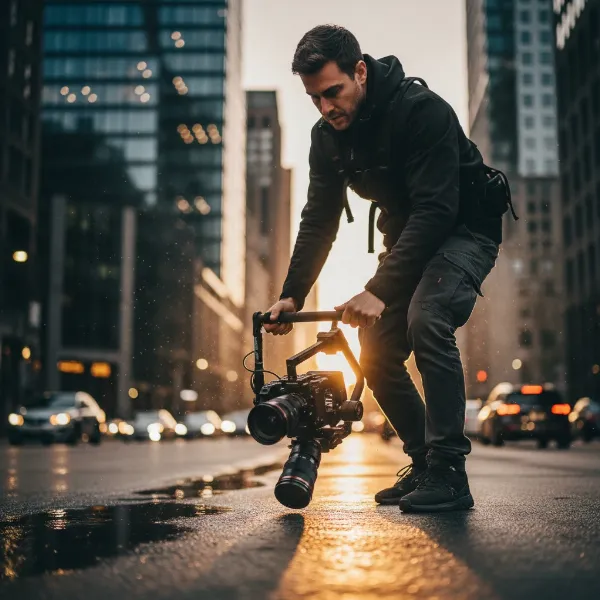 A cinematographer operating a camera gimbal in underslung mode with a sling handle attached for low-angle shots.
Conclusion
The distinction between sling mode and underslung mode is more than just technical jargon; it represents a fundamental understanding of how to maximize the potential of your camera gimbal. Underslung mode unlocks a world of creative low-angle perspectives, enabling filmmakers to capture unique and engaging shots. Sling handles, in turn, provide the ergonomic and functional backbone, making these challenging shots more comfortable, controllable, and achievable for longer durations. By comprehending and strategically applying both concepts, videographers can elevate their craft, create more dynamic content, and enhance their overall shooting experience. Which mode will you master first to transform your next project?
Frequently Asked Questions
Can I use underslung mode without a sling handle?
Yes, most gimbals can be operated in underslung mode without a dedicated sling handle. However, using a sling handle often provides superior ergonomics, comfort, and control, especially for extended periods or complex movements.
Do all camera gimbals support underslung mode?
Most modern three-axis camera gimbals are designed to support underslung operation. Always consult your gimbal’s user manual or specifications to confirm its capabilities and recommended setup for this mode.
Is “Sling Mode” a specific setting or button on a gimbal?
No, “Sling Mode” is generally not a specific electronic setting on a gimbal. Instead, it refers to the physical configuration of attaching and utilizing a specialized “sling handle” accessory to improve the gimbal’s handling and ergonomics.