In the dynamic world of video production, achieving buttery-smooth, stable footage is paramount to creating professional and engaging content. Whether you’re a seasoned filmmaker or an aspiring vlogger, the quest for fluid camera movement inevitably leads to two dominant stabilization technologies: the Steadicam and the motorized gimbal. While both promise to eliminate jarring shakes and jitters, their operational principles, aesthetic outputs, and ideal use cases differ significantly. Understanding these distinctions is crucial for making an informed decision that aligns with your creative vision, technical requirements, and budget. This comprehensive guide will delve into the intricacies of each system, empowering you to select the perfect tool to elevate your cinematography.
Understanding Camera Stabilization
At its core, camera stabilization aims to isolate the camera from unwanted movements, allowing for seamless tracking shots, fluid pans, and steady handheld sequences. These tools counteract the natural instability of human movement, transforming shaky footage into cinematic artistry. The methods employed by stabilizers can be broadly categorized into mechanical and electronic, each offering a unique approach to achieving that coveted smooth look.
What is a Steadicam?
The Steadicam, a brand name that has become synonymous with mechanical camera stabilization, is a robust system comprising a body-worn vest, an articulated iso-elastic arm, and a camera sled. Invented in the 1970s, it revolutionized filmmaking by allowing operators to capture incredibly smooth, “flying” shots without the need for cumbersome tracks or dollies. The camera is meticulously balanced on the sled with counterweights, creating a low center of gravity. The magic happens as the articulated arm connects the sled to the operator’s vest, absorbing shocks and isolating the camera from their body movements, including footsteps.
Advantages of a Steadicam
- Organic, Cinematic Feel: Steadicams are renowned for delivering a natural, human-like cinematic aesthetic. The footage often possesses a subtle sway and graceful rhythm, mimicking human perception rather than robotic precision, which is ideal for narrative filmmaking and emotional storytelling.
- No Battery Dependency for Stabilization: Being a purely mechanical system, a traditional Steadicam does not rely on electronic motors or batteries for its core stabilization function, eliminating concerns about power failures during critical shots.
- Superior Shock Absorption: The articulated arm excels at absorbing significant shocks and vibrations, allowing operators to navigate challenging terrains, ascend stairs, or move rapidly while maintaining frame integrity.
- Ergonomic for Heavy Rigs: The body vest distributes the camera’s weight across the operator’s torso and hips, making it possible to operate heavy cinema cameras for extended periods with less fatigue.
- Extensive Range of Motion: Steadicams offer an unparalleled range of motion, enabling complex, three-dimensional movements and transitions from high to low angles that might be difficult for gimbals.
Disadvantages of a Steadicam
- Steep Learning Curve: Mastering a Steadicam requires immense practice, coordination, and physical endurance. It’s a highly specialized skill that often takes months or years to perfect, making it less accessible for beginners.
- Time-Consuming Setup: Balancing a Steadicam is a meticulous process, demanding careful adjustments to counterweights and fine-tuning, which can consume significant production time.
- Bulky and Less Portable: Full Steadicam rigs are typically large and heavy, making them less portable and cumbersome for productions with frequent location changes or limited space.
- Higher Initial Cost (for professional rigs): High-end professional Steadicam systems can be a substantial investment, often ranging from tens of thousands of dollars.
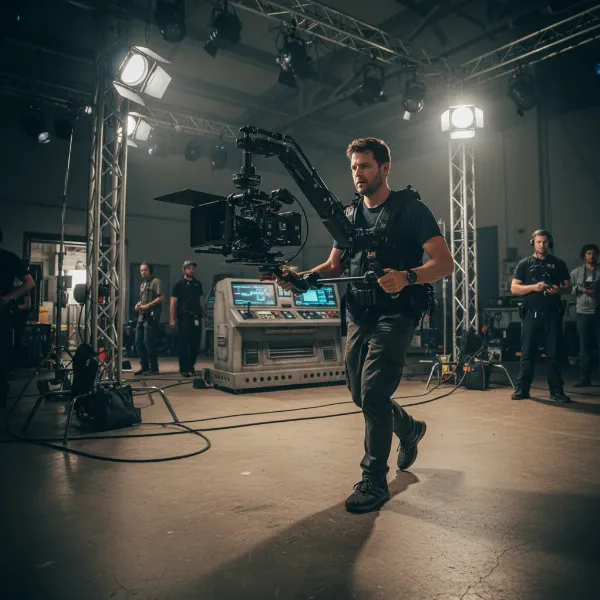 Professional Steadicam operator capturing smooth footage with a large camera rig and body vest on a film set.
What is a Motorized Gimbal?
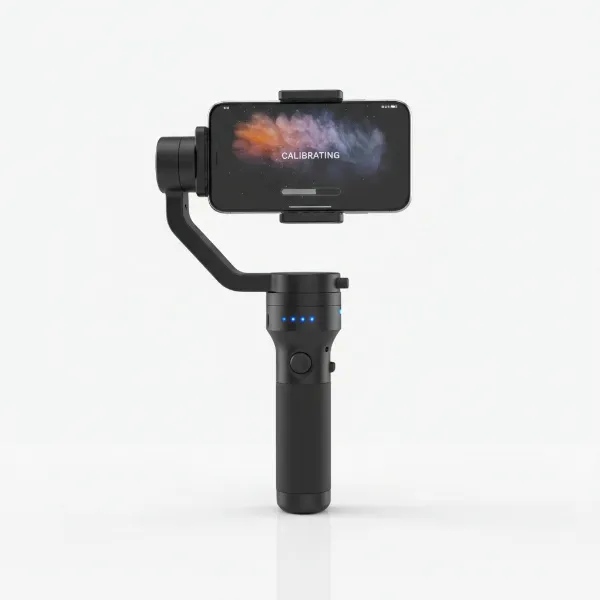
A motorized gimbal is a more modern, electronic stabilization device that utilizes brushless motors and advanced sensors (accelerometers and gyroscopes) to counteract unwanted camera movements. Most gimbals offer three-axis stabilization, correcting for pan (yaw), tilt (pitch), and roll. As the operator moves, the motors actively adjust the camera’s position in real-time, maintaining a level horizon and smooth movement.
Advantages of a Motorized Gimbal
- Ease of Use & Accessibility: Gimbals are significantly easier and faster to learn and operate compared to Steadicams, making professional-looking smooth footage accessible to a wider range of creators, from hobbyists to solo filmmakers.
- Quick Setup and Rebalancing: Gimbals generally boast a quicker setup time and can be rebalanced relatively fast when changing camera bodies or lenses, minimizing downtime on set.
- Precise, Robotic Movement: Gimbals excel at delivering digitally precise, impeccably smooth movements. This “robotic” aesthetic is often preferred for dynamic action shots, product videos, or vehicle-mounted footage.
- Compact and Portable: Many gimbals are designed to be lightweight and compact, making them highly portable and suitable for travel or run-and-gun shooting scenarios.
- Smart Features: Modern gimbals often integrate intelligent features such as subject tracking, time-lapse modes, panorama functions, and remote control via smartphone apps, enhancing creative possibilities.
- Versatility in Deployment: Gimbals can be used handheld, mounted on tripods, jibs, cranes, or even vehicles, offering flexibility in shot execution. They also fit well into tight spaces where larger rigs cannot.
Disadvantages of a Motorized Gimbal
- Battery Dependency: Gimbals require batteries to power their motors and electronics, necessitating careful battery management and potentially limiting continuous shooting time.
- “Floating Head” Effect: While gimbals excel at rotational stability, some handheld models may struggle to completely isolate the camera from vertical “bobbing” caused by an operator’s footsteps, leading to a “floating head” look without a dedicated Z-axis arm.
- Potentially “Sterile” Look: The extreme precision of gimbals can sometimes result in footage that feels overly smooth or “sterile,” lacking the organic human touch that a Steadicam provides.
- Weight Limitations: Smaller, more affordable gimbals typically have lower weight capacities, limiting the size and weight of cameras and lenses they can effectively stabilize.
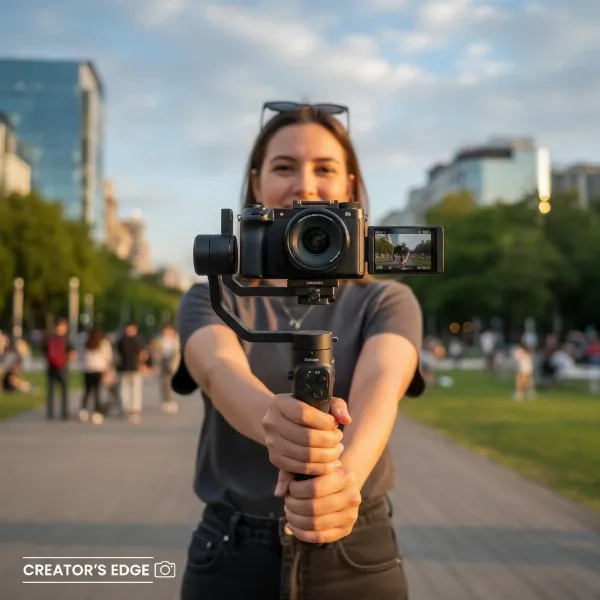 Videographer using a compact handheld motorized gimbal with a mirrorless camera for stable video.
Key Factors When Choosing a Stabilizer
Deciding between a Steadicam and a motorized gimbal boils down to a careful evaluation of your specific project needs, budget, and operator experience.
Stabilization Technology
Consider whether you prefer the purely mechanical, inertia-based stabilization of a Steadicam or the electronically assisted, real-time correction of a gimbal. Each offers distinct advantages in how movement is handled.
Ease of Use & Learning Curve
Gimbals generally have a much gentler learning curve, making them suitable for those new to stabilization. Steadicams demand significant dedication and practice to master the subtle art of operation.
Setup Time & Portability
If you require quick setup, fast transitions between shots, and high portability for travel or dynamic environments, a motorized gimbal will likely be more efficient. Steadicams demand more meticulous balancing and are less convenient for rapid deployment.
Camera Compatibility & Weight Capacity
Evaluate the weight of your camera and lens setup. While some modern gimbals can support heavier cinema cameras, traditional Steadicams often excel at carrying substantial rigs for extended durations due to their body-worn design.
Cost & Budget
Motorized gimbals typically offer a lower entry point, with many high-quality options available for a few hundred to a few thousand dollars. Professional Steadicam rigs, especially those with vests and arms, represent a more significant investment.
Battery Life & Power
If long, uninterrupted takes are crucial and access to charging is limited, the mechanical Steadicam offers inherent reliability. Gimbals, conversely, require regular charging and battery swaps.
Shot Style & Application
Think about the desired aesthetic. A Steadicam delivers an organic, “flying” feel ideal for narrative filmmaking and emotional intimacy, while a gimbal provides precise, “robotic” smoothness perfect for fast-paced action or dynamic commercial work.
Detailed Comparison: Steadicam vs. Motorized Gimbal
| Feature | Steadicam | Motorized Gimbal |
|---|---|---|
| Stabilization Method | Mechanical (counterweights, inertia) | Electronic (motors, sensors) |
| Setup Time | Longer, meticulous balancing | Quicker, easier balancing |
| Learning Curve | Steep, requires significant practice | Gentle, user-friendly |
| Portability | Less portable, bulky | Highly portable, compact |
| Power Source | None (mechanical operation) | Batteries (electronic motors) |
| Aesthetic Output | Organic, cinematic, natural flow | Precise, robotic, digitally smooth |
| Best Use Cases | Narrative film, long takes, walking shots, heavy rigs | Action, vlogging, commercials, quick cuts, lightweight rigs |
| Vertical Stability | Excellent (arm isolates Z-axis) | Good (can suffer “floating head” without Z-axis attachment) |
| Weight Capacity | High (especially vest-based systems) | Varies, typically lower than pro Steadicam |
| Cost (Entry Level) | Moderate (Glidecam type) to Very High (pro) | Low to Moderate |
Making the Right Choice: A Buying Guide
When navigating the world of camera stabilizers, pinpointing the perfect fit means aligning your equipment with your specific production ecosystem.
Budget Considerations
Set a realistic budget from the outset. Entry-level gimbals are highly accessible, making them excellent choices for hobbyists or those starting out. If your projects demand the ultimate in organic movement and you have the funds, a Steadicam system or professional operator rental might be warranted.
Define Your Needs and Project Type
Are you shooting dynamic sports events, intimate interviews, or cinematic narratives? The nature of your projects dictates the most suitable stabilizer. For fast-paced, documentary-style work, a quick-to-deploy gimbal is often superior. For carefully choreographed, long takes that demand a “human” feel, a Steadicam shines.
Operator Experience Level
Be honest about your current skill set. If you’re new to stabilization, a gimbal offers immediate gratification and professional results with less training. If you’re willing to invest significant time and effort into mastering a craft, a Steadicam offers unparalleled creative control.
Camera Gear and Workflow
Consider your current camera setup. Most mirrorless and DSLR cameras pair beautifully with modern gimbals. If you’re working with larger, heavier cinema cameras and need to maintain mobility, a robust Steadicam system designed for heavy loads is a more appropriate choice. Also, factor in your power needs; if you often shoot in remote locations without easy access to power, the battery-free operation of a Steadicam offers peace of mind.
Tips for Using and Maintaining Your Stabilizer
Regardless of your choice, proper usage and maintenance will extend the life of your equipment and ensure optimal performance.
- Regular Balancing: Always balance your camera system meticulously. For gimbals, this ensures efficient motor operation and extends battery life. For Steadicams, it’s fundamental to achieving any stable shot.
- Cleanliness is Key: Keep motors (for gimbals) and pivot points (for both) free from dust and debris. Use a soft, dry cloth to wipe down surfaces regularly.
- Firmware Updates: For motorized gimbals, regularly check for and install firmware updates to ensure you have the latest features and performance enhancements.
- Battery Care: For gimbals, store batteries with a partial charge (around 50-60%) and avoid over-discharging or overcharging them to prolong their lifespan.
- Safe Transport: Always transport your stabilizer in a dedicated case to protect delicate components from impacts and environmental factors.
“The choice between a Steadicam and a motorized gimbal isn’t about one being inherently ‘better’ than the other; it’s about selecting the right tool for the specific story you’re trying to tell and the unique demands of your production.” – Jane Doe, Professional Cinematographer
Conclusion
The journey to achieve smooth camera movement often presents a crossroads between the classic, mechanical artistry of the Steadicam and the modern, electronic precision of the motorized gimbal. Each stabilization system offers distinct advantages and disadvantages, catering to different production styles, budgets, and operator skill levels. While the Steadicam provides an organic, human-like cinematic feel for complex, long takes with heavy rigs, it demands significant operator mastery and setup time. Conversely, motorized gimbals offer quick deployment, ease of use, and digitally perfect stability, making them highly accessible for dynamic, fast-paced shooting with smaller camera setups.
Ultimately, the decision rests on your specific creative vision and practical requirements. Do you prioritize the nuanced, flowing movement of a seasoned Steadicam operator, or the immediate, versatile precision of a motorized gimbal? By carefully weighing the unique characteristics of each, you can confidently choose the camera stabilizer that will empower you to capture stunning, professional footage and truly bring your storytelling to life.
What kind of stories are you eager to tell with perfectly smooth camera movements?
Frequently Asked Questions
Is a Steadicam still relevant in the age of advanced gimbals?
Absolutely. While gimbals have democratized smooth footage, the Steadicam remains highly relevant for professional productions that require its unique organic, human-like movement, superior Z-axis isolation, and ability to carry very heavy cinema camera rigs for extended periods without battery concerns.
Can a motorized gimbal achieve the same “floating” look as a Steadicam?
Motorized gimbals can produce incredibly smooth footage, but they often struggle to replicate the exact “floating” and organic quality of a well-operated Steadicam. This is particularly true for vertical (Z-axis) movement, where the Steadicam’s articulated arm offers a level of isolation that many handheld gimbals cannot match without additional accessories.