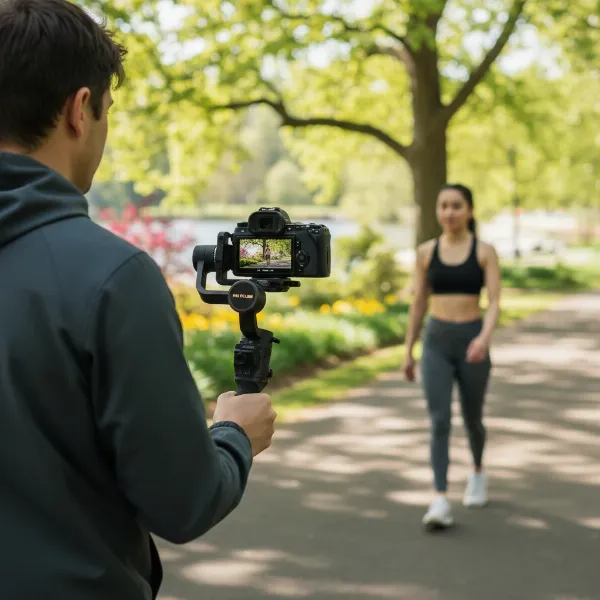
In today’s fast-paced digital world, vertical video reigns supreme on platforms like TikTok, Instagram Reels, and YouTube Shorts. Gone are the days when horizontal was the only way to shoot; now, mastering the vertical frame is essential for capturing attention and telling compelling stories. While handheld phone footage can be shaky and unprofessional, a gimbal transforms your mobile device or camera into a cinematic powerhouse, delivering butter-smooth, stable shots that truly stand out. If you’re ready to elevate your vertical content from amateur to expert, this comprehensive guide will walk you through everything you need to know, from initial setup and precise balancing to advanced filming techniques and camera settings.
Understanding Vertical Video for Social Media
|
Our Picks for the Best Washing Machine in 2026
As an Amazon Associate I earn from qualifying purchases.
|
||
| Num | Product | Action |
|---|---|---|
| 1 | COSTWAY Portable Washing Machine, Twin Tub 26lbs Capacity Laundry, 18lbs Washer and 8lbs Spinner Combo with Timer Knobs, Built-in Drain Pump, Compact Washer for Home Dorm Apartment (Grey+White) |

|
| 2 | Giantex Portable Washing Machine, 21lbs Capacity, 14.4lbs Washer and 6.6Llbs Spinner, Compact for Apartment RV, White & Gray, GT-GE-10390US-GR-FP |
|
| 3 | Portable Washing Machine,16L Upgraded Large Capacity Portable Washer With 3 Modes Deep Cleaning.Suitable For Travel, Camping,Apartments, Dormitories, Hotels (Green) |
|
| 4 | Avanti Portable Compact Washing Machine for Clothes/Laundry, 0.84 Cu. Ft. Capacity, Standard Sink/Faucet Attachment for Apartment, Dorm, RV, White |
|
| 5 | COSTWAY Portable Washing Machine, Twin Tub 26 Lbs Capacity, 18 Lbs Washer and 8 Lbs Spinner, Compact Washer with Control Knobs, Timer Function, Drain Pump, Laundry washer for Apartment RV, Blue |
|
| 6 | Giantex Portable Washing Machine, 20lbs Capacity, Twin Tub 2lbs Washer & 8lbs Spinner Combo, Compact for Apartment RV Dorms, Blue & White, GT24267-PE |
|
| 7 | Portable Washing Machine - Compact 2.0 Cu.ft Portable Washer, Full-Automatic Top Loader for Space Saving, Ideal for Apartments, Homes, and Dorms, 10 Wash Cycles, Low Noise, IPX4 with Drain Pump |
|
| 8 | COSTWAY Portable Washing Machine, Twin Tub 26lbs Capacity Laundry Washer, 18lbs Washer and 8lbs Spinner Combo with Timer Knobs, Built-in Drain Pump, Compact Washer for Home Dorm Apartment, Blue+White |
|
| 9 | Giantex Portable Washing Machine, 17.6lbs Compact Washer Spinner Combo with Pump Drain, Twin Tub 11lbs Wash & 6.6lbs Spin, Lavadoras Portatiles for Apartment RV Dorm College (White & Blue) |
|
| 10 | Waterjoy Portable Washing Machines, 7.7 lbs Load Capacity Portable Washer and Dryer Combo with Built-in Barrel Light & LED Display for Household and Apartment (Blue) |
|
Vertical video, typically with a 9:16 aspect ratio, has become the native language of short-form social media. This format is designed for optimal viewing on smartphones, filling the entire screen and immersing the viewer in the content. Embracing vertical isn’t just about rotating your phone; it’s about rethinking composition and movement to leverage the taller frame effectively. Ignoring this shift means missing out on engagement and reach, as platforms prioritize content optimized for their specific user experience.
Choosing the Right Gimbal Setup for Vertical Shooting
The approach to setting up your gimbal for vertical video can vary depending on your equipment. Whether you’re using a smartphone or a dedicated camera, understanding the options is key to achieving the best results.
Native Vertical Mounts
Many modern gimbals, especially those designed for smartphones or smaller mirrorless cameras, come with a built-in feature or a dedicated quick-release plate that allows for direct vertical mounting. This is often the most straightforward method, as the gimbal is designed to accommodate the vertical orientation with minimal fuss. However, some native vertical mounts might make it harder to monitor your shot effectively [cite: 2 in search 4].
Camera Cages & L-Brackets: The Professional Approach
For professional cameras like DSLRs or mirrorless systems, or even some advanced smartphones, a camera cage combined with an L-bracket offers superior flexibility and balance. Instead of forcing the camera’s native horizontal mount into a vertical position, you mount the camera horizontally into a cage, and then attach the cage (with the camera inside) to the gimbal vertically using an L-bracket or a vertical quick-release plate. This method often provides better screen visibility and balance, crucial for professional-grade vertical footage [cite: 1, 2 in search 1, 4 in search 1].
Smartphone Gimbals: Simplicity and Portability
Smartphone gimbals are generally more intuitive for vertical shooting. Most models feature a quick flip mechanism or a dedicated mode that rotates your phone into portrait orientation. While they might lack some of the advanced features of larger camera gimbals, their ease of use and portability make them perfect for on-the-go content creation for TikTok and Reels.
Step-by-Step Gimbal Balancing for Vertical Video
Achieving perfectly smooth vertical video starts with impeccable balancing. An unbalanced gimbal will strain its motors, lead to shaky footage, and quickly drain your battery. This process is critical, regardless of your gimbal model.
Preparation: A Level Start
Before you begin, ensure your gimbal is placed on a flat, stable surface. Extend all its arms and unlock all three axes (pan, tilt, and roll). Remove any lens caps, filters, or accessories you plan to use, as these will affect the weight distribution.
Mounting Your Device Vertically
Carefully mount your smartphone or camera onto the gimbal’s vertical quick-release plate or L-bracket. If using a camera cage, ensure the camera is securely fastened within the cage first, then attach the cage to the gimbal’s vertical mount. Always make sure the lens is facing forward.
Balancing the Tilt Axis
This is often the first and most crucial axis to balance. First, unlock the tilt axis and point your camera straight up. Adjust the camera’s position (usually by sliding it forward or backward on the mounting plate) until it stays suspended without falling forward or backward [cite: 5 in search 2]. Next, tilt your camera so it’s facing directly forward (level). Adjust again, this time sliding the camera up or down, until it remains level without drifting upwards or downwards when released [cite: 1 in search 2]. Lock this axis once balanced.
Balancing the Roll Axis
With the tilt axis locked, unlock the roll axis. The camera should remain perfectly level, not tilting to either side. If it rolls, loosen the corresponding adjustment knob and slide the camera or gimbal arm left or right until it stays horizontal on its own [cite: 2 in search 2]. Re-lock the roll axis once achieved.
Balancing the Pan Axis
Finally, unlock the pan axis. Hold your gimbal at a 45-degree angle. The roll axis arm should naturally stay at this 45-degree position without swinging. If it does, adjust the pan arm (usually by extending or retracting it) until the gimbal remains stable at the 45-degree angle. This ensures even weight distribution across the entire setup [cite: 2 in search 2].
Fine-Tuning with Auto-Calibration
Once all axes are manually balanced, most gimbals offer an auto-tune or auto-calibrate function via their companion app. This process allows the gimbal motors to learn the precise weight of your setup and optimize their power output, ensuring the smoothest possible stabilization. Don’t skip this step for peak performance [cite: 3 in search 2, 4 in search 2].
Mastering Gimbal Modes for Dynamic Vertical Content
Different gimbal modes offer distinct control over your camera’s movement, allowing you to achieve a variety of cinematic vertical shots for your TikToks and Reels.
Pan Follow Mode (PF)
In Pan Follow mode, the tilt and roll axes are locked, but the pan axis follows your horizontal movement. This is ideal for smooth tracking shots where you want to follow a subject moving from side to side while maintaining a stable horizon. It’s also excellent for vlogging or showcasing a landscape as you walk, keeping the frame steady while allowing you to turn with your subject.
Tilt Lock Mode: Steady Forward Motion
Tilt Lock mode, sometimes referred to as ‘Follow Mode’ on some gimbals, keeps the horizon level and the camera pointing straight forward, even as you move up and down or walk on uneven terrain. This is fantastic for walking tour videos or any shot where you need consistent, stable forward motion without unwanted vertical shifts [cite: 1 in search 3]. However, be mindful that on very steep inclines, it might struggle to maintain a perfectly level horizon [cite: 1 in search 3].
Follow Mode (Pan & Tilt Follow): Dynamic Subject Tracking
Also known as Pan & Tilt Follow, this mode unlocks both the pan and tilt axes, allowing the camera to smoothly follow your hand movements horizontally and vertically. It’s incredibly versatile for tracking subjects, performing reveal shots, or capturing dynamic movements where you need to look up, down, or around your subject. This freedom of movement can create engaging and immersive vertical narratives [cite: 2, 3, 5 in search 3].
POV Mode: Unleashing Creative Angles
POV (Point of View) mode unlocks all three axes—pan, tilt, and roll—giving you complete freedom of movement. This allows for highly creative, dynamic shots where you can twist, turn, and roll the camera for an immersive, first-person perspective or unique cinematic effects. Use this mode when you want to inject a sense of motion and energy into your vertical clips [cite: 2, 3 in search 3].
Sport Mode/Go Mode: Rapid Response
Many gimbals feature a “Sport Mode” or “Go Mode” designed for fast-paced action. This mode increases the motor’s response speed, allowing the gimbal to react more quickly to sudden movements. It’s perfect for capturing intense action sequences, tracking fast-moving subjects, or achieving rapid transitions in your vertical videos.
“The key to compelling vertical video is not just stability, but intentional movement. A gimbal doesn’t just steady your shot; it empowers you to choreograph your camera’s dance.” – Sarah Chen, Mobile Filmmaking Expert
Essential Filming Techniques for Professional Vertical Videos
Beyond simply stabilizing your shots, a gimbal unlocks a world of creative possibilities for vertical content. Think about how to maximize the tall frame to tell your story.
Composition for the Tall Frame
Vertical composition demands a different eye. Instead of the wide landscapes of horizontal video, focus on leading lines that draw the eye up or down, or stack elements within the frame. Use the height to emphasize towering subjects, create a sense of depth by placing elements in the foreground and background, or compose tight shots that focus on facial expressions or intricate details. Avoid wide-angle lenses for close-ups, as they can cause noticeable distortion [cite: 1, 4 in search 4].
Utilizing Focal Lengths
Experiment with different focal lengths to control perspective and focus. Tighter focal lengths (zooming in) can help compress the background, drawing attention to your subject and filling the vertical space more effectively. This creates a more intimate and focused look, preventing unwanted visual information from cluttering the frame [cite: 1 in search 4].
Creative Gimbal Movements
- Push-in/Pull-out with Tilt: Smoothly walk towards or away from your subject while simultaneously tilting the camera up or down. This adds a dynamic layer to a simple reveal or emphasis.
- Orbit Shot: Walk in a circle around your subject while keeping the camera focused on them. This creates a mesmerizing, professional-looking revolving shot.
- Dolly Zoom (Vertically): While some gimbals have this feature built into their apps, you can manually attempt a vertical dolly zoom by physically moving towards or away from a subject while simultaneously zooming in or out. This creates a disorienting, dramatic effect perfect for short-form narratives.
- Whip Tilt Transitions: Use quick, deliberate upward or downward tilts at the end of a clip to transition dramatically into the next scene. This is a highly effective and popular technique in vertical video [cite: 1 in search 4].
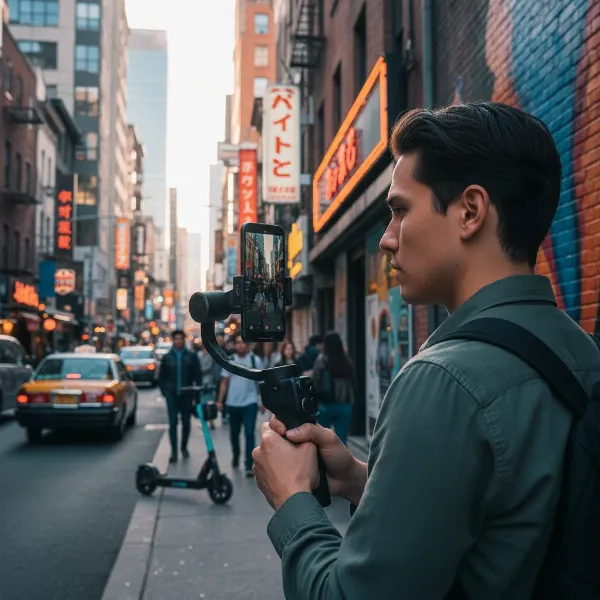 A person using a smartphone gimbal to shoot vertical video for TikTok or Reels with smooth movement
Smooth Transitions
Gimbals excel at making your transitions seamless. Beyond whip tilts, consider slow, deliberate pans or tilts that lead the viewer’s eye from one element to another. Practice “match cuts” where the end of one gimbal movement perfectly aligns with the start of the next, creating a sense of continuous motion.
Optimizing Camera Settings for TikTok & Reels
While your gimbal handles stability, your camera settings are crucial for capturing high-quality vertical footage that shines on social media.
Resolution and Frame Rate
For most social media platforms, shooting in 4K resolution at 24 frames per second (fps) offers a cinematic look that is visually appealing and highly adaptable for editing [cite: 5 in search 1]. If you plan to incorporate slow-motion effects, capturing footage at 1080p resolution at 60fps or 120fps will provide buttery-smooth playback when slowed down [cite: 5 in search 1].
Shutter Speed for Cinematic Motion
The “180-degree rule” is a golden standard in filmmaking: set your shutter speed to double your frame rate. For example, if shooting at 24fps, use a 1/50th-second shutter speed. This creates natural motion blur, making your video look smoother and more cinematic. Deviating from this for specific effects is fine, but for general smooth footage, stick to this rule [cite: 5 in search 1].
Focus Techniques
For dynamic vertical content featuring movement, continuous autofocus (AF-C) is often your best friend, ensuring your subject stays sharp. However, for static shots where precise focus is paramount, manual focus gives you ultimate control and can prevent unwanted focus hunting [cite: 5 in search 1].
White Balance and Picture Profiles
Set your white balance manually to match the lighting conditions of your environment. This prevents distracting color shifts between clips and ensures consistent color temperatures. For those who plan to color grade, shooting with a flat picture profile (like a LOG profile if your camera has one) will capture more dynamic range, providing greater flexibility in post-production [cite: 5 in search 1].
Audio Considerations
Even if your vertical video is primarily visual, good audio is often overlooked. If you’re recording dialogue or important sound, connect an external microphone directly to your camera or phone. Always monitor and check your audio levels before filming, aiming for levels between -12dB and -6dB to avoid clipping or muffled sound [cite: 5 in search 1].
Troubleshooting Common Vertical Gimbal Issues
Even with the best preparation, you might encounter issues. Here’s how to tackle them:
- Motor Strain/Vibration: This is almost always a sign of improper balancing. Re-balance your gimbal meticulously, paying close attention to each axis. Ensure all locks are disengaged when balancing and engaged when moving the gimbal.
- Drifting/Unwanted Movement: If your camera slowly drifts to one side, it indicates a slight imbalance that needs fine-tuning. Re-calibrate the gimbal motors using the app. Sometimes, magnetic interference can also cause this, so try shooting in a different location.
- Difficulty Balancing Heavy Setups: If your camera and lens combination is pushing the gimbal’s weight limit, consider using counterweights. These small weights attach to the gimbal arms to help achieve proper balance for heavier loads [cite: 4 in search 1].
- Screen Obstruction: If your camera’s screen is blocked by the gimbal arm in vertical mode, consider using an external monitor or flipping the gimbal upside down (underslung mode) if your setup allows for a better viewing angle. The camera cage method often alleviates this by allowing the screen to face the operator [cite: 1 in search 1].
Conclusion
Mastering vertical video with a gimbal for TikTok and Reels is a game-changer for content creators. By carefully setting up and balancing your equipment, understanding the nuances of different gimbal modes, and applying intentional filming techniques, you can transform your everyday footage into professional, captivating narratives. The journey to cinematic vertical content requires practice and experimentation, but the results—smooth, engaging, and polished videos—are well worth the effort. Now, go out and create something amazing that truly stands out!
Ready to take your vertical storytelling to the next level? What’s the first cinematic vertical shot you’ll try with your gimbal?
Frequently Asked Questions
Can I use any gimbal for vertical video?
While many modern gimbals offer native vertical shooting modes or adapters, older models might require workarounds like L-brackets or camera cages to properly mount your device in a vertical orientation. Always check your gimbal’s specifications and features before attempting a vertical setup.
How do I know if my gimbal is perfectly balanced?
A perfectly balanced gimbal will hold its position on any axis (tilt, roll, or pan) when you release it, without drooping or drifting. The motors should also operate quietly and effortlessly. If you feel any resistance or hear motor strain, it’s a sign that further balancing adjustments are needed.
Is a smartphone gimbal sufficient for professional vertical videos?
For many TikTok and Reels creators, a high-quality smartphone gimbal is more than sufficient. Modern smartphone gimbals offer excellent stabilization, intelligent tracking features, and are highly portable. However, for advanced cinematic control and flexibility, a gimbal designed for larger cameras (mirrorless/DSLR) may be preferred.