Agitator vs Impeller Washing Machine
Quick Verdict: Agitator washers win on mechanical cleaning power for heavy cotton items — workwear, towels, denim — and typically use a full water fill that some buyers prefer for rinsing. Impeller (HE) washers win on capacity (larger drum for the same exterior size), energy and water efficiency, and gentler action on mixed and delicate loads. For most modern households doing mixed laundry, a well-designed impeller washer is the more versatile choice. For households dominated by heavy-duty cotton washing, the agitator earns its place.
Agitator vs Impeller: Side-by-Side Comparison
| Feature | Agitator Top-Load | Impeller (HE) Top-Load |
|---|---|---|
| Cleaning Action | Mechanical — center post moves clothes through water | Wash plate rotation creates water current to move clothes |
| Best For | Heavy cotton, workwear, denim, towels | Mixed loads, delicates, large/bulky items |
| Drum Capacity | 3.0–4.5 cu. ft. typical | 4.5–6.0 cu. ft. typical |
| Water Use per Cycle | Higher — full fill typical | Lower — auto-sensing fill |
| Energy Efficiency | Moderate | Better — HE certified |
| Fabric Wear | More aggressive — can stress delicate fabrics | Gentler on most fabrics |
| Cycle Time | Typically shorter (45–55 min) | Often longer (55–75 min) |
| Price Entry Point | ~$600+ | ~$500+ |
| Tangling Risk | Higher — agitator post can tangle sheets and large items | Lower |
| Typical Warranty Tier | Speed Queen: 7-year; others: 1-year standard | Maytag motor: 10-year limited; others: 1-year standard |
How We Evaluated These Washer Designs
This comparison synthesizes independent expert research from Consumer Reports, Reviewed.com, and Yale Appliance, alongside published specifications for key models in each category. We focused on the performance dimensions that distinguish agitator and impeller designs in real-world household use. No placement fee was received from any manufacturer.
How Agitators Clean
A traditional agitator is a center post in the drum that twists and oscillates during the wash cycle, physically pulling clothes through a full tub of water repeatedly. This mechanical action is effective at dislodging dirt and soil from the surface of fabrics — particularly dense, heavy cotton items that benefit from direct mechanical contact. It is the technology that washing machines used for decades before high-efficiency designs became the market norm.
The Speed Queen TR7 is the premium agitator benchmark — its commercial-grade agitator and transmission are engineered for decades of heavy use and consistent performance on the kind of tough loads an agitator handles best.
How Impellers Clean
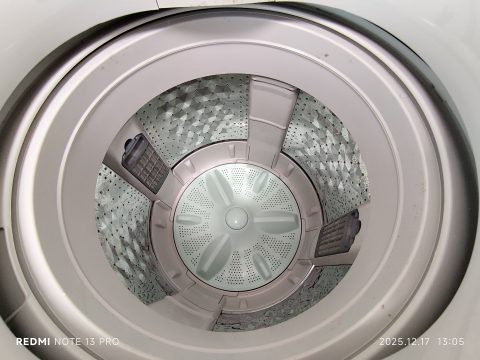
An impeller is a low-profile wash plate at the bottom of the drum that rotates to create a rolling current through a reduced water level, which carries clothes around the drum and creates fabric-on-fabric friction that dislodges soil. Because the center post is absent, the drum can be significantly larger for the same exterior cabinet — enabling the 5.0–6.0 cu. ft. capacity common in HE top-loaders. Auto-sensing water level fills only as much water as each load requires, reducing consumption substantially.
The Maytag MVW7232HW with its Power impeller and reverse wash motion represents the performance ceiling for impeller design in this price tier — rated above average for an HE top-loader on tough stains by Reviewed.com.
Wash Performance on Different Fabric Types
On heavy cotton — work shirts, jeans, thick towels, athletic socks — agitators have a genuine performance edge. The direct mechanical action of the post moving through fabric is more effective at removing ground-in soil from thick materials than an impeller’s water current. Consumer Reports notes that speed-queen-style agitator performance on cotton workwear is competitive with top-rated front-loaders.
On delicate fabrics — knitwear, lingerie, synthetic blends — the impeller’s gentler action is the better choice. Agitators can stretch, pull, and damage delicate items through direct mechanical stress; impellers move fabrics more gently. For large, bulky items like comforters and quilts, impeller drums’ larger capacity and reduced tangling risk also give them the advantage.
Water and Energy Use
Impeller HE machines use significantly less water per cycle. A traditional agitator typically fills to a level that submerges the load — 30–45 gallons — while an HE impeller’s auto-sensing fill might use 13–20 gallons for a medium load. Over a full year of regular use, this represents a meaningful difference in water bills and environmental footprint. Energy Star efficiency ratings for HE impeller machines are consistently higher than for agitator-based designs.
Capacity
Without a center post occupying drum space, impeller washers offer more usable capacity for the same cabinet footprint. A 27-inch wide top-loader with an agitator typically offers 3.2–4.5 cu. ft.; the same exterior with an impeller delivers 4.5–5.3 cu. ft. For large households, families with king-sized bedding, or anyone who wants to wash a comforter at home rather than at a laundromat, the impeller’s capacity advantage is practically significant.
Strengths and Limitations Summary
Agitator Strengths:
- Superior mechanical cleaning action on heavy cotton, denim, and workwear
- Shorter typical cycle times
- Full water fill preferred by some buyers for thorough rinsing
- Speed Queen’s agitator design is backed by unmatched warranty and durability engineering
Agitator Limitations:
- Smaller drum capacity for the same cabinet size
- Higher water consumption per cycle
- Can tangle sheets and large items around the post
- More aggressive on delicate fabrics — increased wear over time
Impeller Strengths:
- Larger usable drum capacity (5.0–6.0 cu. ft.) in the same cabinet footprint
- HE efficiency — lower water and energy use
- Gentler on mixed and delicate fabrics
- Auto-sensing adapts water level to actual load size
Impeller Limitations:
- Slightly less mechanical cleaning force on heavy, densely woven fabrics
- Longer cycle times than agitator machines
- Can cause tangling in some large items if overloaded
Which Should You Choose?
Choose an Agitator If:
Your household primarily washes heavy cotton — work clothes, uniforms, athletic socks, thick towels — and you want maximum mechanical cleaning force. The Speed Queen TR7 is the premier choice for durability-focused agitator buyers.
Choose an Impeller If:
You wash a mix of fabric types, need maximum capacity, prioritize water and energy efficiency, or regularly wash large items like comforters. The Maytag MVW7232HW with its Power impeller and Extra Power button addresses the cleaning-intensity concern while delivering 5.3 cu. ft. of drum space.
Frequently Asked Questions
Do agitator washers clean better than impeller washers?
It depends on what you are washing. Agitators clean heavy cotton items more effectively through direct mechanical action. On mixed loads, delicates, and synthetic fabrics, a well-designed HE impeller performs comparably or better. Consumer Reports testing shows top-rated HE impeller washers like the Maytag MVW7232HW score closely with agitator designs on normal soil across a range of fabric types.
Are agitator washers bad for clothes?
Agitators are more aggressive on fabrics than impellers, which can accelerate wear on delicate items over time. For heavy-duty cotton, this is not a meaningful concern. For knitwear, lingerie, fine blends, and delicate synthetics, the agitator’s mechanical action presents more fabric stress than an impeller. Most agitator washers include a Delicates cycle that reduces agitation intensity, but they are still not the ideal choice for a wardrobe heavy with delicate items.
Which type is more water efficient?
Impeller HE washers are meaningfully more water efficient. Auto-sensing water levels and lower fill requirements result in roughly 50–70% less water use per cycle compared to traditional agitator full-fill machines. Over a year of regular use, this represents substantial water and utility savings.
Can I wash a king comforter in an agitator washer?
Only in a large-capacity agitator machine — the center post reduces usable drum space and can prevent large items from moving freely, resulting in poor washing and potential tangling. A high-capacity impeller washer (5.0+ cu. ft.) handles king comforters significantly better. If bulk washing is a priority, an impeller design is more practical.
Last updated: June 2026
See our main guide: Best Washing Machines.